Last year, you may recall, I tried Bell's Rye stout - the first and only rye beer I'd ever had. I wasn't amazed by that brew (I gave it a B), but it was intriguingly smooth and bready. Enough to make me curious as to what everyone else was doing with this stuff, barley's meaner cousin. Surely there had to be some interesting beers out there using it. And, as a result, I've spent the last couple of months gathering a few together for a comparison.
Without further ado, the beers are:
-the Rye Hopper from the French Broad Brewing Co. in Asheville,
-the Cane and Ebel from Two Brothers in Warrenville (about an hour west of Chicago),
-the Bitter Woman in the Rye from Tyranena in a mysterious location between Madison and Milwaukee,
-the Hop Rod Rye from Bear Republic in Cloverdale CA, and finally
-Red's Rye PA (that's not a typo) from Founders in Grand Rapids.
Most of these are basically IPAs with rye in them, although a few (particularly the Two Brothers entry) look like genuine oddballs. They range from obscure 5.9% lightweights (the Rye Hopper) to nationally distributed 8% monsters (the Bear Republic entry). I'm genuinely curious as to what these taste like, and which is best.
So, let's start with the underdog first: the Rye Hopper. French Broad is a tiny little brewery (I've been there!) nestled in on the south side of Asheville. I tried a couple of their beers while I was down there (their Wee Heavier, by the way, is quite good) and grabbed a bomber of this particular treat to go. The bottle design is, let's say, uninspired. This, to my mind, is no bad thing - it may just mean they've put the money they would've otherwise spent on a guy with a macbook into their beer. And, well, since this is my first rye beer after the Bell's I don't really know what to expect from it. But I've come to trust that these folks know what they're doing.
Well, it pours a lovely and rich amber color, with about a finger and a half's worth of off-white head. The aroma is initially more hoppy than anything else - good all-American citrus, IPA stuff. Actually, you'd be totally justified in taking this stuff as an IPA prima facie. But don't be fooled, because a little deeper in there's definitely something different: the malts are really bready, almost earthy, like a field on a dry day. That, presumably, would be the rye, then. There's a little bit of the usual caramel note from the malts in there too, but the stars here are definitely the good ol' California hops and that funky rye malt.
The taste, too, initially fooled me into thinking "India Pale." Initially there's that penetrating Christmas tree bitterness characteristic of American IPAs, but then it takes a hard left turn. Where I expect it to develop into caramel and more citrus, it suddenly becomes spicy and bready - mouth-coveringly so, although not in the cloying way that the Bell's sometimes flirted with. It's a pure, uncomplicated moment of rye, and I like it. The ending is more traditional - your usual IPA slap of sharp citrusy hops - but after the hops die away the aftertaste, again, is really dominated by the spicy bread notes. The stuff clings on like crazy, which really only makes me want to drink more.
This is a fine brew. The more I drink it the more I notice a lonely bit of caramel sweetness way way in the back trying to moderate things, but it doesn't really have a chance: this stuff is very dry and shamelessly bitter. It's like drinking a caraway and cascade smoothie (maybe a little less thick). The mouthfeel may be right smack dab in the middle, but it's still surprisingly full-bodied for a mere 5.9 percenter. I like this stuff a lot, and I'm liking it more and more as I near the bottom of the bottle. It's a sipper, to be sure - there's just way too much flavor here to drink it with any speed - but it's never overwhelming, and it never gets old. I'd even be tempted to call this a perfect dinner beer, if I could think of something to pair it with (lamb, maybe?).
But that's enough of the Rye Hopper for now, because we've got more beers to do. For our second rye offering, we move from the mountains of Asheville to the flatlands of Illinois. And if French Broad was going for an IPA with rye (a RyePA, as Founders would have it), a hoppy sipper of an ale with spicy bready notes, then the the Two Brothers folks seem to be up to something entirely different. Just look at how they describe this stuff on their website. Simcoe and summit hops? "Thai palm sugar"? Who do these guys think they are, Dogfish Head? Originality definitely seems to be number one here, so here too I don't know entirely what to expect.
The Cane and Ebel pours a very dark ruby-amber shade, much darker than the French Broad entry. This time there's only a one-finger head or so, and it quickly retreats - this is a seven-percenter to the previous 5.9, remember. And the aroma. Wow, that's different. It starts off hoppy - a oddly fruity kind of bite mixed with some of the usual citrus notes. There's some toffee in there too, from the malts. It's all very civil and normal, right up until the point where you give it a few swirls - and suddenly the nose goes insane. Mango? Vanilla? Cherries? Peaches? Cloves? It's an astonishing cloud of flavors, one of the most complex and elusive noses I've ever come across. The only thing missing, really, is the rye notes I was expecting. Maybe they've just been outdone here. In any case, it's a fabulous aroma and I'm nearly ready to recommend this stuff by smell alone. Unless it tastes like a sewer pipe, it's not getting lower than a B.
It doesn't taste like a sewer pipe. As a matter of fact, it's really, really nice. The taste certainly isn't as varied as the smell, but how could it be? And surprisingly - considering the crazy ingredients and the extra alcohol - it's actually easier to drink than the previous entry. Smoother than a newly-buffed bowling ball, this stuff. The front end's a caress of sweet and sour malt, plus a peck of bitter hops (not up there with a serious imperial IPA, but you definitely know they're there). Towards the middle it gets even sweeter, way sweeter than the Rye Hopper, and at the same time the familiar spicy-grainy rye flavors start to creep in. This is where the beer wins me over: the combination of bready rye and sweet malt and sugar is phenomenal. Then there's the hoppy bite followed by the bready aftertaste - but again, much sweeter this time out. Some might find the sugar slightly too much here, but I totally dig it. And this is an aftertaste that'll last awhile, too, if you let it - but you won't, because you're already taking another sip.
This is a fantastic beer; I've absolutely fallen in love. And I shouldn't have: normally I adore stouts and dopplebocks, heavy dark malty stuff, and not ridiculous hoppy sugary bready things. But just look at me, I'm sucking this bottle down like a fish. And when I'm done, I'll probably want another (which I don't have). In a strange way this actually reminds me of the Celebrator: there's that same sense of, "there's no way something this complex should be so drinkable." It's hard to find any flaws at all. Again, someone without my sweet tooth may find it too sugary, but that's literally the worst thing one can say. Other than that, this beer is pretty much perfect.
It's the mark of first drinking an A-level beer that the world is a little bit different afterwards. And here that's true in the usual sense - it's set a new standard, almost a new genre- but also in another one as well. Before, if you wanted to head to the store and buy a truly great beer made roundabouts the Chicago area, you had to choose between the Yankees-esque and rather boring Goose Island and the brilliant but cultish Three Floyds... and that was mostly it (maybe Half-Acre too, but you have to look around a bit for them). Now, however, there's a third way. Two Brothers are a little crazy, but affordable and available; they aren't totally ubiquitous nor the cheapest option, but neither are they going to only sell their most famous beer on one day a year. They've become, as it were, the Bill Clinton of Chicago brewing. If they can keep making beers like this, everyone else should be very worried.
But we must be moving on. I honestly didn't think the Two Brothers would be quite so good; I was expecting to wander through these first few rather unremarkably, letting the favorites clean up at the end. But now I may have hit the summit early. Whatever the case, I feel a bit of sympathy for the beer up next in line. And, oh lord, it happens to be Tyrenena's Bitter Woman in the Rye. There's an uphill battle in store for the folks from Wisconsin.
Now, I tried Tyrenena's normal Bitter Woman IPA sometime last year and I rather liked it. It's not particularly strong (like some American IPAs) in terms of alcoholic muscle, but it more than makes up for it by firing a great big grapeshot load of bitter fruity hoppiness directly into your mouth and sinuses. What they've done here, I suppose, is make pretty much the same beer and throw some rye into the recipe. No indication at all of how strong this is, but the original was in the high five range (5.75%) and I expect about the same here.
Well, it pours almost exactly like the Rye Hopper - beautifully amber-colored, with a quickly-receding one-finger head. I suppose I should expect that, given that both beers are more or less modified IPAs: this beer looks like one and smells like one. But it's quite a lot sweeter-smelling than I recall from the original Bitter Woman - the caramel malts are right up front, and the classic west coast hops come following behind. The hops actually come across as pretty subdued compared (once again) to the Rye Hopper. And, of course, there's the same bready notes from the rye. It's a nice aroma, and I think I actually prefer it over the French Broad offering - at the price of a little power there's a touch more depth, although nowhere near the variety of Cane and Ebel. (Compared to that masterpiece, this nose - as good as it is - loses out hard.)
When you sip it, BWitR comes across quite a lot less sweet than you'd think it would (although it's still moreso than the Rye Hopper). Sweet honey is first up, along with a nibble of hops. There's more sugar and bitterness throughout the middle, but it's only at the end that the grainy, spicy, bready rye taste peeks in. Unlike the last two beers, though, it never really takes over. Actually, this has by far the least rye flavor of anything here. The aftertaste is more caramel malt, hops, and more of what remains from the (rather half-hearted) rye infusion.
In essence, BWitR is what it says on the label: more than the Rye Hopper, this isn't so much a "rye beer" as an IPA with rye added. The results are pretty good, albeit outclassed in this company. What's most interesting about this experiment, though, is that they somehow ended up with something less exciting than what they started out with. In the end, this is a beer that can't quite decide what it wants to be: the addition of rye rounds out the aggressive hop edge, lessening its power as an IPA, but there's not enough extra character to carry it somewhere else. On the other hand, this rather muddled status makes it very appealing for a different role. To my taste, Bitter Woman with rye in it becomes something of a party beer - were it not so tough to find, I'd definitely think about substituting it in for a more typical (mild) IPA the next time I'm playing host. It's not something that'll give anyone a revelation, but you could very easily entertain a group for a few hours with a six-pack or three.
But once again, it's time to move on. At last, here it is: the daddy. The Hop Rod Rye.
This beer intimidates by what's on the bottle alone. The ugly flaming 1930s hot rod coupe (were they watching The California Kid for inspiration?) may initially seem goofy, but in geeky microbrewer vocabulary it screams "Don't fuck with me, I'm serious." The only way to do this better is to transpose a hop blossom onto a skull and crossbones. And then there's the text - the scary bits aren't so much the ones that say "made with 18% rye," but the ones that say "8% alcohol by volume" and "Sediment at bottom of bottle may be a result of the truckload of hops." And this is even before you notice that BeerAdvocate ranks this as the 71st best beer in the world, the only rye beer to make the top 100. So I'm fully expecting this to kick my ass.
Let's give her a pour, then.
Holy lord that's hoppy. The California explodes out of the bottle the moment I pop the cap, and it only gets more dense as I pour the stuff. The color is actually quite similar to the Two Brothers - a kind of very dark amber, perhaps a few shades bleaker than the previous entry. And as promised, there are indeed floaties, and lots of them. The head is cream flaked with orange, two fingers' worth, a foamy monster that sticks around despite the alcohol dragging it south. Holy mother is this going to be strong. The aroma dies down a bit after a moment, but a swirl or two brings it right back. Yup, all hops. There's not even a nod towards balancing here - no real malts in the aroma at all, not even the rye, just grapefruit and pine needles as far as the nose can smell. It doesn't have anywhere near the nuance of the Cane and Ebel, but then that's not the point. This is all about brute force, shock and awe, sheer scale. When Heidegger evoked the category of the "enormous," he was thinking about this beer.
The first moment you sip it, however, you suspect something's gone wrong. There's a tiny citrus bite on the tongue up front, but in the middle it's actually extremely well-behaved. Hell, there's even a nice baked toffee flavor in there and way more maltiness than one would have expected from the smell. It's nice, it's soothing. You might even begin to relax. And then you swallow, and all hell breaks loose.
There's nothing subtle about how this brew behaves at the back of your mouth; it's as if the skies simply open up and drop a sharp piney firestorm onto your pretty malt paradise. This moment right here, the split-second in which you swallow a mouthful of HRR, is the essence of California brewing. It's the Summa Hopologiae if you will. If you love such beer then you owe it to yourself to stop reading this right now and go pick up a bottle immediately. And strangely enough, it's the rye that first provides some relief to all this. It slowly, slowly cuts its way through the forest of christmas trees and grapefruits to supply its characteristic earthy-grainy taste. The rye totally dominates the aftertaste (which is, of course, very dry), sitting alongside a load of residual hops. And neither is going away for awhile - not until you take another sip (which you will).
Alcohol? Well, I can tell it's stronger than the other three, but not by a lot (I would have guessed in the low sevens). The mouthfeel is creamy but (inexplicably) pretty light for such a monster - like the others, I suspect this is down to the rye contents. Like the Rye Hopper and BWitR, this is a California IPA at heart with rye added for a bit of character. Unlike the Tyranena entry, the two are complimentary: there's no way I could enjoy a beer this hoppy without something special to provide relief, and the rye does that brilliantly.
This is the best of the rye IPAs so far. All three are all uncomplicated, wonderful slices of hoppy Americana. But while the Hopper is an Olds 442 - quirky and obscure, but still a brute - and the Woman in the Rye is a 'Stang - strangely civil in spite of itself - the Hop Rod Rye is a Hemi Barracuda. It's not pretty, neither is it subtle. It's got more power and probably more insanity than a third world dictator. It's one of the most distinctive beers I've ever had, But - dare I say? - in the end I believe I still prefer Two Brothers with their Ferrari Daytona.
There's one more beer to review here, but it's one I bought significantly later than the others (like, by a couple of weeks). It's the entry from Founders, Red's (so-called) Rye PA. Although the competition isn't exactly fresh in my mind, I couldn't post this comparo in good faith without trying this stuff, since - with the possible exception of the Bear Republic entry - it's by far the most common beer of this sort. So: how does it stack up?
Well, like the French Broad and Tyrenena beers, it pours a nice amber orange. It's a shade or two darker than the others, although not quite into Bear Republic territory. The head, too, gives itself about a finger before sinking back into the depths. And, unsurprisingly, this is quite hoppy - close to imperial IPA territory, in fact. Nothing like the sheer force of the previous entry, but in return there's a bit more nuance: along with the typical grapefruit smells there's a nice, freshly-mowed grass sort of aroma. It's not rye, not that I can tell anyways, but it's rather nice. And, with a bit of agitation, the malts come right out: I detect lots of caramel and toffee smells, but still no rye. Hmm.
The flavor profile is, well - it's rather like the Rye Hopper, really, only not as good. There's a bit of sharp piney bitterness up front, just like an IPA, and then the rye hits - only instead of being a kind of spicy sandwich, as the French Broad is, this one slaps you with a mouthful of wet construction paper. It's definitely rye, but it's all gone wrong somehow: it should make me want to drink more, not scrape my mouth out with a chisel. Fair enough, there are some sweeter malts in here fighting back, but it's pretty pointless: in its middle sections this beer is basically like drinking newspaper. The finish is a little bit better, if only because it goes back to an old-fashioned imperial IPA citrus bomb. But even that's not enough to save it, as the aftertaste is really not pleasant - again, the rye taste sticks around like my mouth's been coated with paper mache.
I don't like this beer at all. And it's actually pretty watery compared to the others. And I can taste the extra alcohol (6.6%), although it's not quite as strong as the HRR. Is there anything at all that's good about this beer? Well... I suppose it gets slightly easier to drink after awhile... but that's like saying you get used to being smothered with paper towels after it happens a few times. And it's still no excuse not to go for a regular imperial IPA. I suppose it's pretty smooth too, although the paper flavors rather ruin that too. So, yes, this is not at all to my taste. But some might like it, I suspect: if you like hoppy beers with long, raspy finishes, this could be your brew. I'll leave it to you; you can have it.
I dunno. This is the second Founders in a row which I've hated; maybe I'm just not getting it? Maybe I have an irrational dislike of the company? Maybe. But, to my judgment, this is easily the least-successful of the IPA-with-rye brews. Bear Republic rounded out a beer that would otherwise be too brutal; French Broad added an interesting middle section to a good ol' fashioned IPA; Tyranena rather unwittingly made a rather solid session beer. What, exactly, have Founders done? I can't really say they failed, because I have no idea what they were going for in the first place.
Red's Rye seems to me, at best, like a novelty. "Rye beer! Wow!" It's around, perhaps, so that folks can try it once and impress their friends. But if you must drink such a thing - and you should - take it from me: there are better examples out there. At least five, in fact, counting these and the Bell's.
French Broad Rye Hopper
Grade: B+
Summary: A delicious spicy grapefruit sandwich on rye. Okay, that doesn't sound remotely appealing, but trust me: it works.
Two Brothers Cane and Ebel
Grade: A
Summary: It tastes like hoppy grain candy, and it smells like a bunch of fruit having an orgy in a pâtisserie.
Tyrenena Bitter Woman in the Rye
Grade: B
Summary: It'd be perfect for your average grad school departmental party. Shame it's so hard to find.
Bear Republic Hop Rod Rye
Grade: A
Summary: A bottle of flaming hop juice, otherwise nigh-undrinkable, is mediated and made into a tour de force by a big dollop of rye. I'd still take the C&E most days, though.
Founder's Red's Rye PA
Grade: C-
Summary: Dip the New York Times in a good IPA and then chew on it for awhile, and I think you'll get roughly the same effect.
Saturday, April 3, 2010


Monday, March 22, 2010
Vacation Roundup: Thomas Creek Stillwater Vanilla Cream Ale and Pump House Porter
Another week, another pair of beers I grabbed in Asheville. This time it's a couple of brews from the Thomas Creek Brewery in Greenville, SC; I haven't heard of them, but then again I'd never heard of the folks at Ceylon either. So, let's see what these southern boys've got for us.
First up from Greenville folks is the Stillwater Vanilla Cream Ale, apparently a summer seasonal. I bought it, among a number of other appealing choices, because I had no idea what any of the words in that name were doing together and it sounded interesting. The bottle, however, is not that interesting: it features two guys fishing and a funky logo, and could basically be mistaken for an organic root beer of some kind.
Anyhow it's a cream ale, a style with which I am not well-acquainted. With the exception of a Genesee I had a few years ago (which I don't remember liking) I don't think I've ever had a one. This could be a new experience, then. And the website confirms this in one sentence: this beer is "a light-bodied and golden American style cream ale with a highly refreshing palate and an undertone of pure vanilla essence." So they actually put vanilla into this stuff? Oh, man. I have enough misgivings about chocolate and coffee - vanilla has the potential to dominate a beer like an angry mistress with a snake whip. Here goes.
It pours a pale, lemony yellow with a fizzy one-finger white head. It looks a little like a macrobrewed lager, to be honest. Only when you stick your head in do you notice what's special, and - surprise! - it's the vanilla. It doesn't totally take over the smell, but nor does it integrate with the rest of it - which is mainly pale malts and some light hops, your standard pilsner stuff. The vanilla aroma just sort of floats on top of this, like oil on water, and it comes and goes. Let the glass sit for a moment and the sweet vanilla notes come wafting out; give it some agitation and the malts snatch the aroma right back. It's odd.
The taste is also odd. It's nice, so long as you don't drink too much or too fast. Take just a sip at a time and the unusual combination works beautifully: the vanilla arrives at the beginning and holds place like an ostinato, while the bitter but light beery flavors wax and wane over it. Drink it with patience and the sour and bitter qualities of the malts, rather than taking over the vanilla, give it a lovely flattering contrast. Try to drink too quickly, however, and things go wrong: the malts and (rather wimpy) hops take over right from the beginning, with the vanilla only coming out in the aftertaste (and not pleasantly so). Sucking it down is clearly not the right way to quaff this stuff - a fact that makes it a poor choice for everyday use, and about as far from the pilsner norm as you can get. It's a smooth beer too (it had better be, at 4.5% abv), light and carbonated - which makes it all the more strange that it sucks to drink fast.
It's an interesting thought, this beer, but does it work? Sipped for a half-hour it's extremely interesting, but other than that it's just too subtle, too delicately balanced, too easy to ruin. And this is a summer seasonal, exactly the sort of beer where you don't want subtlety. Weird flavor additives go in abbey ales and stouts, not in glorified pilsners there to provide refreshment in the heat. And despite this fact, despite all the reason in me screaming that this isn't a good beer, I'm liking it more and more with every sip. The vanilla tends to linger, and over the course of the bottle it very slowly begins to win its battle against the malts. The result is that this gets better as it goes along; it gains character and complexity, rather than just getting warm and nasty. I still don't think the idea quite works, but no matter the season I'd take a single failure like this over a dozen decent but identical wheatbeers and pale lagers.
Since this beer is basically sui generis, and is likely to remain so, I don't think I can grade it. It exists for the sake of the curious, and I think that's how it should be.
The second and last entry from the Greenvillians appears to be more pedestrian. It's a porter, and one with a less boring but somehow even more more unremarkable bottle than the last one. I prefer to link images large enough that you can actually see something, but here it doesn't really matter - this label really looks like it should be the cover of a now-forgotten alt rock album released circa 1995. But we're not here to be catty about designs, we're here to drink beer. Let's crack this open.
Well, it pours very dark indeed - not quite pitch black, but the light only barely passes through it. The head's almost nonexistent, something I don't expect from a brew this weak (a mere 5.75% abv), and what little there is quickly settles into a foam. It more than redeems itself in the aroma, though: this smells absolutely fantastic. It's not really a typical porter smell - think of an imperial stout dialed back a few notches and with the fuzz pedal turned off. There's a pure, rich cacao and cherries smell here, interlaced with nuts, caramel, and a little bit of cinnamon. I get a roasted malt aroma, too, although it's not the most prominent thing in the nose by far. I am absolutely in love. I may have to move to South Carolina in the near future if the beer itself is as good as its smell.
...It isn't. It's not bad, though. The front end, surprisingly, is the sweetest part of the taste profile, a kind of toffee taste with a bit of smoke to it. This gets taken over rather quickly by cacao and charcoal, although the roasted malts are never too intrusive. Everything else is more of the same: the bittersweet, smoky character hangs on through the aftertaste, which lasts forever (as it should). The finish is a bit dry, but not excessively so. In a lot of ways this reminds me of the Edmund Fitzgerald porter - there's that same sense of roasted malts barely kept under restraint. The Pump House isn't really in the same league as that monster, but it's still a fine beer. Its greatest flaw is that it's rather watery; if you can get past that and emphasize the smell of the stuff, it'll make a fine little session porter.
Overall? Well, if I graded entirely on aroma this would be well into the high A range. The taste and the texture aren't quite there yet, though. Give it a shot if you see it on a shelf somewhere - although if it's between this stuff and the Cream Ale, I'd grab the latter for novelty value alone.
Nice work all around, Thomas Creek. I look forward to trying more of your stuff whenever I'm in the neighborhood.
Thomas Creek Stillwater Vanilla Cream Ale
Grade: n/a
Summary: On the Island of Misfit Beers, this thing is in the aristocracy. Try it.
Thomas Creek Pump House Porter
Grade: B
Summary: Tastes like an ashy but pretty good porter. Smells like a spicy chocolate and cherry party in heaven.
First up from Greenville folks is the Stillwater Vanilla Cream Ale, apparently a summer seasonal. I bought it, among a number of other appealing choices, because I had no idea what any of the words in that name were doing together and it sounded interesting. The bottle, however, is not that interesting: it features two guys fishing and a funky logo, and could basically be mistaken for an organic root beer of some kind.

Anyhow it's a cream ale, a style with which I am not well-acquainted. With the exception of a Genesee I had a few years ago (which I don't remember liking) I don't think I've ever had a one. This could be a new experience, then. And the website confirms this in one sentence: this beer is "a light-bodied and golden American style cream ale with a highly refreshing palate and an undertone of pure vanilla essence." So they actually put vanilla into this stuff? Oh, man. I have enough misgivings about chocolate and coffee - vanilla has the potential to dominate a beer like an angry mistress with a snake whip. Here goes.
It pours a pale, lemony yellow with a fizzy one-finger white head. It looks a little like a macrobrewed lager, to be honest. Only when you stick your head in do you notice what's special, and - surprise! - it's the vanilla. It doesn't totally take over the smell, but nor does it integrate with the rest of it - which is mainly pale malts and some light hops, your standard pilsner stuff. The vanilla aroma just sort of floats on top of this, like oil on water, and it comes and goes. Let the glass sit for a moment and the sweet vanilla notes come wafting out; give it some agitation and the malts snatch the aroma right back. It's odd.
The taste is also odd. It's nice, so long as you don't drink too much or too fast. Take just a sip at a time and the unusual combination works beautifully: the vanilla arrives at the beginning and holds place like an ostinato, while the bitter but light beery flavors wax and wane over it. Drink it with patience and the sour and bitter qualities of the malts, rather than taking over the vanilla, give it a lovely flattering contrast. Try to drink too quickly, however, and things go wrong: the malts and (rather wimpy) hops take over right from the beginning, with the vanilla only coming out in the aftertaste (and not pleasantly so). Sucking it down is clearly not the right way to quaff this stuff - a fact that makes it a poor choice for everyday use, and about as far from the pilsner norm as you can get. It's a smooth beer too (it had better be, at 4.5% abv), light and carbonated - which makes it all the more strange that it sucks to drink fast.
It's an interesting thought, this beer, but does it work? Sipped for a half-hour it's extremely interesting, but other than that it's just too subtle, too delicately balanced, too easy to ruin. And this is a summer seasonal, exactly the sort of beer where you don't want subtlety. Weird flavor additives go in abbey ales and stouts, not in glorified pilsners there to provide refreshment in the heat. And despite this fact, despite all the reason in me screaming that this isn't a good beer, I'm liking it more and more with every sip. The vanilla tends to linger, and over the course of the bottle it very slowly begins to win its battle against the malts. The result is that this gets better as it goes along; it gains character and complexity, rather than just getting warm and nasty. I still don't think the idea quite works, but no matter the season I'd take a single failure like this over a dozen decent but identical wheatbeers and pale lagers.
Since this beer is basically sui generis, and is likely to remain so, I don't think I can grade it. It exists for the sake of the curious, and I think that's how it should be.
The second and last entry from the Greenvillians appears to be more pedestrian. It's a porter, and one with a less boring but somehow even more more unremarkable bottle than the last one. I prefer to link images large enough that you can actually see something, but here it doesn't really matter - this label really looks like it should be the cover of a now-forgotten alt rock album released circa 1995. But we're not here to be catty about designs, we're here to drink beer. Let's crack this open.

Well, it pours very dark indeed - not quite pitch black, but the light only barely passes through it. The head's almost nonexistent, something I don't expect from a brew this weak (a mere 5.75% abv), and what little there is quickly settles into a foam. It more than redeems itself in the aroma, though: this smells absolutely fantastic. It's not really a typical porter smell - think of an imperial stout dialed back a few notches and with the fuzz pedal turned off. There's a pure, rich cacao and cherries smell here, interlaced with nuts, caramel, and a little bit of cinnamon. I get a roasted malt aroma, too, although it's not the most prominent thing in the nose by far. I am absolutely in love. I may have to move to South Carolina in the near future if the beer itself is as good as its smell.
...It isn't. It's not bad, though. The front end, surprisingly, is the sweetest part of the taste profile, a kind of toffee taste with a bit of smoke to it. This gets taken over rather quickly by cacao and charcoal, although the roasted malts are never too intrusive. Everything else is more of the same: the bittersweet, smoky character hangs on through the aftertaste, which lasts forever (as it should). The finish is a bit dry, but not excessively so. In a lot of ways this reminds me of the Edmund Fitzgerald porter - there's that same sense of roasted malts barely kept under restraint. The Pump House isn't really in the same league as that monster, but it's still a fine beer. Its greatest flaw is that it's rather watery; if you can get past that and emphasize the smell of the stuff, it'll make a fine little session porter.
Overall? Well, if I graded entirely on aroma this would be well into the high A range. The taste and the texture aren't quite there yet, though. Give it a shot if you see it on a shelf somewhere - although if it's between this stuff and the Cream Ale, I'd grab the latter for novelty value alone.
Nice work all around, Thomas Creek. I look forward to trying more of your stuff whenever I'm in the neighborhood.
Thomas Creek Stillwater Vanilla Cream Ale
Grade: n/a
Summary: On the Island of Misfit Beers, this thing is in the aristocracy. Try it.
Thomas Creek Pump House Porter
Grade: B
Summary: Tastes like an ashy but pretty good porter. Smells like a spicy chocolate and cherry party in heaven.
Friday, March 19, 2010
Micreview: Guinness Extra Stout and Murphy's Stout
Well, it's the night after St. Patty's. And, although I may be late about it, I suppose I'm a obligated to review some Irish stouts. But there's a problem: I think the big names are shite, to be honest, including and especially all the Guinness I've had. I'm told, of course, that I've never had the real Guinness - and I reserve an open mind for if I try a pint of it one day - but I can state with certainty that all the Guinness that I've had in Chicago bars or in cans has been a muted watery mess not worth the material used to brew it.
Let's see, then, if a bottle of the Extra Stout does any better. This particular example was proudly brewed in Toronto,Canada Ireland, and it's got the same cream-on-black bomber design you've seen in every grocery store everywhere (especially in March). So: is it any good?
Well, it certainly looks like a stout should, pouring jet-black with a finger and a half of tan head. The nose is rather unassuming, though: the coffee-like note of roasted barley comes first, and there's also just a little bit of fruit if you concentrate. Sour fruit, not sweet - underripened cherries, maybe. It's not bad, but it's nothing to knock you over, either by detail or by raw power.
The taste is quite dry, as it should be, and fuller than I recalled. There's a touch of cacao at the start, which then expands into a full-on roasted malt frenzy. Halfway through it's chiefly lots and lots of charcoal and cacao, with a sweet-and sour note sneaking in towards the end. The hops aren't exactly no-shows, but they don't do much to relieve matters: mostly they just seem to add a slightly rusty effect, which isn't great. The aftertaste, to no one's surprise, is dry, consisting entirely of the bitter, lingering roasted flavors. It's a decent brew, I guess - it's a hell of a lot better than the nitro stuff they sell in bars - but it still fails to have any hook for me. The thing I'm most disappointed in, I think, is the mouthfeel: initially I found this stout rather full-bodied and creamy, but halfway through the bottle it's getting increasingly watery with every sip.
This beer, I would say, is exactly average. If you've got some roasted goose on the carvery (or some really nice Swiss cheese) and you need a beer to pair with it, this'll do nicely: it does its bitter thing, and it does it well. Beyond that, though, there's not much need to bother. It's really not worth drinking on its own, and the roasted malts do get annoying after awhile.
At this point I was faced with a problem: I wanted something to compare the Guinness to, and there aren't many other stouts with Irish ancestry around aside from the aforementioned Guinness Draught (which I avoid) and Beamish (which I couldn't find). I did find Murphy's Stout, though - four-packs were on sale at Binnys, and I snagged them. It comes in a can, too, which dutifully reports on its side that Murphy's is made in Edinburgh,Scotland Ireland. Should be interesting.
Well, the head on this thing is just amazing - it bubbles up from the bottom and forms a frothy beige of about two fingers. It's absolutely beautiful. And the color, again, is totally black - darker than black, in fact. It's a stereotypical, picture perfect stout appearance, even moreso than the Guinness ES; it looks fantastic. And the nose... the nose is... oh, no. The first thing I notice is that it smells like sour barley. With a little bit of a roasted hue, maybe some lactose and some yeast. And... that's it. It's one of the dullest aromas I've had in awhile, not only in the sense that it's boring but that it actually feels like it's been blunted. Oh, man. I may have made a horrible mistake here.
Onto the taste, where the misses just keep on coming. It's got a smooth consistency, to be sure, but it's also rather watery and unpleasant. Think skim milk. And the flavor? Bzzzt, sorry, there really isn't much. Somewhere - way way in the back - are some traditional Irish stout notes like roasted malts and cacao and a dry finish, but they've been so muted that there's almost nothing left. It's as if someone drew a stout with a pencil, and then erased it (but didn't completely finish the job). No, worse than that: seeing a half-erased stout right in front of one's eyes is still too direct an experience. Drinking Murphy's is like hearing your neighbor down the hall drink an Irish stout.
There's just nothing here. No flavor, no alcohol (4% abv), barely any texture. It's a 16 ounce can of nada that happens to look good when you pour it. I'm not sure exactly what I can blame this on: the can? the apparent nitrogenation of the can? the Edinburghers? Who knows, and I suppose it doesn't really matter. If you like beers that look pretty, get yourself a four-pack asap. If you like good stouts, avoid this stuff like a SARS case.
Really, Ireland, come on. You invented this style, and all you send us is a tasteless draught, a middling beer that any halfway-decent American microbrewer could better, and flavored stoutwater? We get drunk in celebration of your patron saint, dammit. You can do better than this. And until then, I think we should celebrate St. Patty's with stouts that are actually good - like Old #38, Black Hawk, Out of Bounds, or Black Sun, say.
Guinness Extra Stout
Grade: C
Summary: It's an Irish stout. It's roasty and a little dry. Meh.
Murphy's Stout
Grade: D-
Summary: Stout flavors dying cold and alone in a (very pretty) submarine, trapped at the bottom of an ocean.
Let's see, then, if a bottle of the Extra Stout does any better. This particular example was proudly brewed in Toronto,
Well, it certainly looks like a stout should, pouring jet-black with a finger and a half of tan head. The nose is rather unassuming, though: the coffee-like note of roasted barley comes first, and there's also just a little bit of fruit if you concentrate. Sour fruit, not sweet - underripened cherries, maybe. It's not bad, but it's nothing to knock you over, either by detail or by raw power.
The taste is quite dry, as it should be, and fuller than I recalled. There's a touch of cacao at the start, which then expands into a full-on roasted malt frenzy. Halfway through it's chiefly lots and lots of charcoal and cacao, with a sweet-and sour note sneaking in towards the end. The hops aren't exactly no-shows, but they don't do much to relieve matters: mostly they just seem to add a slightly rusty effect, which isn't great. The aftertaste, to no one's surprise, is dry, consisting entirely of the bitter, lingering roasted flavors. It's a decent brew, I guess - it's a hell of a lot better than the nitro stuff they sell in bars - but it still fails to have any hook for me. The thing I'm most disappointed in, I think, is the mouthfeel: initially I found this stout rather full-bodied and creamy, but halfway through the bottle it's getting increasingly watery with every sip.
This beer, I would say, is exactly average. If you've got some roasted goose on the carvery (or some really nice Swiss cheese) and you need a beer to pair with it, this'll do nicely: it does its bitter thing, and it does it well. Beyond that, though, there's not much need to bother. It's really not worth drinking on its own, and the roasted malts do get annoying after awhile.
At this point I was faced with a problem: I wanted something to compare the Guinness to, and there aren't many other stouts with Irish ancestry around aside from the aforementioned Guinness Draught (which I avoid) and Beamish (which I couldn't find). I did find Murphy's Stout, though - four-packs were on sale at Binnys, and I snagged them. It comes in a can, too, which dutifully reports on its side that Murphy's is made in Edinburgh,
Well, the head on this thing is just amazing - it bubbles up from the bottom and forms a frothy beige of about two fingers. It's absolutely beautiful. And the color, again, is totally black - darker than black, in fact. It's a stereotypical, picture perfect stout appearance, even moreso than the Guinness ES; it looks fantastic. And the nose... the nose is... oh, no. The first thing I notice is that it smells like sour barley. With a little bit of a roasted hue, maybe some lactose and some yeast. And... that's it. It's one of the dullest aromas I've had in awhile, not only in the sense that it's boring but that it actually feels like it's been blunted. Oh, man. I may have made a horrible mistake here.
Onto the taste, where the misses just keep on coming. It's got a smooth consistency, to be sure, but it's also rather watery and unpleasant. Think skim milk. And the flavor? Bzzzt, sorry, there really isn't much. Somewhere - way way in the back - are some traditional Irish stout notes like roasted malts and cacao and a dry finish, but they've been so muted that there's almost nothing left. It's as if someone drew a stout with a pencil, and then erased it (but didn't completely finish the job). No, worse than that: seeing a half-erased stout right in front of one's eyes is still too direct an experience. Drinking Murphy's is like hearing your neighbor down the hall drink an Irish stout.
There's just nothing here. No flavor, no alcohol (4% abv), barely any texture. It's a 16 ounce can of nada that happens to look good when you pour it. I'm not sure exactly what I can blame this on: the can? the apparent nitrogenation of the can? the Edinburghers? Who knows, and I suppose it doesn't really matter. If you like beers that look pretty, get yourself a four-pack asap. If you like good stouts, avoid this stuff like a SARS case.
Really, Ireland, come on. You invented this style, and all you send us is a tasteless draught, a middling beer that any halfway-decent American microbrewer could better, and flavored stoutwater? We get drunk in celebration of your patron saint, dammit. You can do better than this. And until then, I think we should celebrate St. Patty's with stouts that are actually good - like Old #38, Black Hawk, Out of Bounds, or Black Sun, say.
Guinness Extra Stout
Grade: C
Summary: It's an Irish stout. It's roasty and a little dry. Meh.
Murphy's Stout
Grade: D-
Summary: Stout flavors dying cold and alone in a (very pretty) submarine, trapped at the bottom of an ocean.
Tuesday, March 16, 2010
Micreview: Lagunitas Cappucino Stout
Well, it's paper-writing week here at the U, and that means I don't have time to conjure up any deep thoughts or big comparative things. Instead I've decided (in brief form) to give the whole "imperial stout with coffee" thing another chance. This may or may not be a horrible idea.
The Lagunitas folks - who are, oddly enough, located about twenty miles north of Lagunitas, in Petaluma - may be from California, but they're fairly ubiquitous here in Illinois somehow. The Binnys website lists 18 of their beers, and I've yet to visit a reputable store without at least a few of their brews in stock. But aside from their IPA - which is almost architypically Californian, to a fault - I've never actually had any of these things. Tonight that changes. The goofy dog on the bottle has sold me, and so I'm trying out their December seasonal: the Cappucino Stout. So, here we go.
Well, it pours black (no surprise there), although when held up to a lamp I can detect some of the light still getting through. Funny enough, it's all ruby at the edges rather than brown. There's a cute little wheat-colored head, too, about a finger's worth, which then quickly dies away (this thing is north of 9% abv, after all). And the aroma - oh, happy days, they've done this one properly. Unlike the Breakfast Stout from Founders, which (you'll recall) I kind of hated, this one comes off as really well-balanced. The coffee is right out front, but kept under control by the addition of a thick ol' slab of sweet malts. Think of a slice of chocolate cake served with a cup of joe and you'll be close. And given a ton of agitation, I can actually detect some hops as well - which, for this kind of beer, is new to me. It's not a nose for the ages (I think I ultimately prefer the Kona Porter), but it's still an unexpectedly pleasant one.
The taste is quite a bit more varied, although it would be a stretch to say that anything about it is totally unexpected. At the front end and quite a ways beyond, this just comes across as a nice, extremely mild imperial stout: lots of bittersweet roasty malts and just a touch of dark fruit. As it moves towards the back of one's mouth, though, the coffee sweeps in like a German panzer brigade. Things get very bitter very fast as the bumble bean swarms over just about everything. And then, right after this, the hops try to push their way through - I can't really tell what sort they are, though, because they're clearly not making much headway against the onslaught. They do provide a lovely touch of dryness to the aftertaste, though, which is otherwise just coffee bitterness and a lingering chocolatey sweetness from the malts. As far as its texture, it comes across as rather thin for the style (not a motor oil, this) but still quite full-bodied and mouth-coating. It's pleasant, but not easy, to drink: you could easily spend a few hours on one bottle.
Bottom line? I like it. It's not something I would drink every day and it still falls short of perfection here and there, but it's a fine beer all the same. It's a good one to split with a group of friends, really, as anyone but a seasoned veteran is going to have trouble finishing a full deuce-deuce of this stuff. It hasn't dethroned the Kona as my favorite coffee beer, but it adds new evidence against my assertion that the idea of such a thing is fundamentally misguided.
Grade: B+
Summary: The first imperial coffee stout I've ever had that actually works.
The Lagunitas folks - who are, oddly enough, located about twenty miles north of Lagunitas, in Petaluma - may be from California, but they're fairly ubiquitous here in Illinois somehow. The Binnys website lists 18 of their beers, and I've yet to visit a reputable store without at least a few of their brews in stock. But aside from their IPA - which is almost architypically Californian, to a fault - I've never actually had any of these things. Tonight that changes. The goofy dog on the bottle has sold me, and so I'm trying out their December seasonal: the Cappucino Stout. So, here we go.

Well, it pours black (no surprise there), although when held up to a lamp I can detect some of the light still getting through. Funny enough, it's all ruby at the edges rather than brown. There's a cute little wheat-colored head, too, about a finger's worth, which then quickly dies away (this thing is north of 9% abv, after all). And the aroma - oh, happy days, they've done this one properly. Unlike the Breakfast Stout from Founders, which (you'll recall) I kind of hated, this one comes off as really well-balanced. The coffee is right out front, but kept under control by the addition of a thick ol' slab of sweet malts. Think of a slice of chocolate cake served with a cup of joe and you'll be close. And given a ton of agitation, I can actually detect some hops as well - which, for this kind of beer, is new to me. It's not a nose for the ages (I think I ultimately prefer the Kona Porter), but it's still an unexpectedly pleasant one.
The taste is quite a bit more varied, although it would be a stretch to say that anything about it is totally unexpected. At the front end and quite a ways beyond, this just comes across as a nice, extremely mild imperial stout: lots of bittersweet roasty malts and just a touch of dark fruit. As it moves towards the back of one's mouth, though, the coffee sweeps in like a German panzer brigade. Things get very bitter very fast as the bumble bean swarms over just about everything. And then, right after this, the hops try to push their way through - I can't really tell what sort they are, though, because they're clearly not making much headway against the onslaught. They do provide a lovely touch of dryness to the aftertaste, though, which is otherwise just coffee bitterness and a lingering chocolatey sweetness from the malts. As far as its texture, it comes across as rather thin for the style (not a motor oil, this) but still quite full-bodied and mouth-coating. It's pleasant, but not easy, to drink: you could easily spend a few hours on one bottle.
Bottom line? I like it. It's not something I would drink every day and it still falls short of perfection here and there, but it's a fine beer all the same. It's a good one to split with a group of friends, really, as anyone but a seasoned veteran is going to have trouble finishing a full deuce-deuce of this stuff. It hasn't dethroned the Kona as my favorite coffee beer, but it adds new evidence against my assertion that the idea of such a thing is fundamentally misguided.
Grade: B+
Summary: The first imperial coffee stout I've ever had that actually works.
Sunday, March 7, 2010
Brown Ale Throwdown: Sprecher Pub Brown Ale, Goose Island Nut Brown Ale, and Big Boss Bad Penny Brown Ale
Yes, this is another one of those things where I pick three random representatives of a style and compare them. What can I say? I'm an academic, comparing approaches comes naturally. And heck, maybe more people will read the site if I can dig a minor niche for myself.
First up is the Pub Brown Ale from Sprecher, a very English-sounding beer that could not possibly look more German. It's a pub ale with a big fuckin' griffin on a shield on the (16oz) bottle design, which just seems wrong somehow. Don't be fooled, though, this thing comes from neither side of the channel. Instead, Sprecher hails from the decidedly less European Glendale, Wisconsin; there they make a number of beers and sodas. I've never tried the beers, but I've had a few of the sodas. I wasn't wowed by their orange soda or ginger ale, but their root beer is heavenly; it'll never top the one from Boylan, which is as complex and serious and magnificent as a psych rock show, but the Sprecher is its sweeter, easy-to-drink alternative whenever I'm feeling a little punk. It's this root beer, then, that encouraged me to hunt down one of their beers (once I found out that they made some).
Oh my, a twist-off cap. It's been a while since I've seen one of those.
Well, it pours rather lightly, with a nice coppery color (not quite brown, but who's complaining) and a one-finger cream head that quickly dies off. It looks like a dark ginger ale, really. The aroma is very promising indeed: not much in the way of hops, but there's plenty of pale malts cut through with caramel, sassafras, and a little bit of earthiness. It's not particularly complex, but it's pleasant enough.
Hm, the taste is in a solid B- territory. It's good stuff, it's the sort of thing I'd drink tons of during a night on the town - "pub ale" is exactly the right term. There's just no real sparkle, though. The front edge is a slightly pearlike sourness, which evolves into a nice soil-and-syrup sort of taste. It's basically your classic earthy/bready brown ale flavor profile. The hops, too, are pretty by-the-book, but they're way turned down even compared to the Bell's brown ale from a while back. Even the mouthfeel is light.
So, then: Sprecher went for simple and mild, and they achieved it. For what it is, then, this brew is pretty good, although I wish they'd been a bit more ambitious. It does strike me as a perfect beer for at least one thing, though: converting the people who've been drinking Pabst their whole lives. Think of this, then, as a beginner beer, not so much a rival to the masters as a (superior) substitute for Newcastle.
Onto the Goose Island Nut Brown, then, which I am on record as declaring not anywhere near as good as their Naughty Goose. It is cheaper and easier to come by, though, and that counts for something. Like all Goose Island brews (excepting the Christmas Ale), this is immaculately packaged in a lovely black-on-brown label. The boys with laptops deserve praise for this one. Also, I should note that I've been saving this bottle roughly since September, so it may be a bit old now.
Well, it pours quite a bit darker than the Sprecher; sort of an auburn, rather than a rust. The head's a tad bit less intense, somewhere just north of a half-finger - I'm chalking this up to the slightly stronger 5.3% ABV. The aroma is very sweet, even sweeter than the Sprecher, but also less detailed (if that's possible). I mainly get caramel, lots and lots of it, with a touch of English hops mixed in. When given some agitation it opens up a tad more, offering more of a coffee aroma; but really, if you're looking for complexity this isn't your beer.
With the taste, I'm feeling even more guilty for accusing the Sprecher of simplicity. This stuff is stupid simple. Most of the hops seem to come through in an initial bitter jab, after which there's nothing but thick milk chocolatey malts. The aftertaste is slightly more dry, but the rest of the time this stuff is shamelessly sugar-driven. And the texture is a bit heavier than the Sprecher as well, although by beer standards I'd still only call it medium-bodied.
I like this beer; it's sweet and kind of unassuming, like the shy kid in class. As a beer, on its own, I'd rank it above the Sprecher, but it also doesn't seem to me to be much of a brown ale. In a lot of ways this is much more comparable to a really mild porter or a sweet stout. Thus it runs into something like the same problem as the Flossmoor Pullman I reviewed last year: it's a good beer, but if I really wanted a brown ale I'd have to go elsewhere.
Last on my list is Bad Penny from Big Boss Brewing. This is another one I picked up from my trip east: these guys make their home in Raleigh, so good luck finding one of these suckers out in Chi-town. It's almost worth it entirely for the bottle alone, though, because it's fucking awesome. It's like they took a movie poster from 1972 featuring a sassy sister making eyes, and just drained all the colors out of it except brown. Yes, I know that doesn't sound appealing, but it works. It even has a bottled-on date: November '09. Well, then - the Goose Island was still okay, so hopefully the months of mellowing have done some good here as well.
It pours very easily indeed, with a moderate brown tone about halfway between the Sprecher and the Goose Island. The head is minimal - maybe a quarter finger tops. Even that's gone after a few seconds, leaving only an off-white floaty foam. The nose is actually quite similar to the other two as well. It's a lovely mix of caramel, nuttiness - well, hell, you've heard this before. I'd say it's right in between the other two, aroma wise, although closer to the Sprecher and perhaps a bit more subdued.
But then there's the taste. Wow, it's not what I expected at all. What strikes me first is that it's surprisingly watery - not that the other two were ultra-creamy, but this one doesn't cover the mouth at all. That's not to say it's bad, though, because the taste makes up for it. It's strikingly bitter, much moreso than the others. Espresso grinds hit right up front and hold on tight while some malty, dark chocolate sweetness slides in behind them. Coffee remains the dominant flavor right up until the end, where the hops deliver an earthy little nibble and let things slide off. The aftertaste is surprisingly long, despite the watery texture: once again it's mostly bitter coffee and chocolate, with (maybe) some almonds to provide relief.
For a night out with the boys I'd choose one of the other two; this is just a little too striking to work for that role. But it's got its own charms, and - in the end - I think I prefer it. Certainly I admire it more as a beer. Bad Penny is like the Bruce Lee of English browns: it packs the maximum amount of force into the minimal effort. It's not a heavy beer, yet features a flavor profile I've found lacking in brews going well into the 8% range. I'm not sure how much use the world has for a beer like this, and I'm not sure whether I myself will ever have it again. But I'm glad it exists.
So: we've got a much narrower spread than I expected here, and not a bad beer in the lot. The Sprecher is boring but also unassuming, the workman of the group, while the Goose Island is pleasant and sweet (but not really properly brownalelich) and the Big Boss is a pint-sized monster (which is a little too watery and not great for pub nights). So: which one should you buy?
Honestly? None of these. Well, try them once for shits and giggles, sure. But if you want a fantastic brown ale, buy the Samuel Smith or the Naughty Goose or Dogfish Head's India Brown. And if you want a relatively cheap, delicious, mild, easily available example of the style for poker nights, the correct decision is in fact Ellie's Brown from Avery. (You can't miss it, it's got an adorable lab on the label.) That's a beer I'll get around to reviewing it one of these days. As it is, though, these three - good as they are - can't beat the standard.
Sprecher Pub Brown Ale
Grade: B-
Summary: A beginner's brown - not bad, just not all that much going on. Your dad will love it.
Goose Island Nut Brown Ale
Grade: B
Summary: Think of this as more of a sweet stout with English-style hops than a real brown. Still good, though.
Big Boss Bad Penny Brown Ale
Grade: B
Summary: The most creative and assertive beer here. Bittersweet, emphasis on the bitter. The wateriness really bugs me, though.
First up is the Pub Brown Ale from Sprecher, a very English-sounding beer that could not possibly look more German. It's a pub ale with a big fuckin' griffin on a shield on the (16oz) bottle design, which just seems wrong somehow. Don't be fooled, though, this thing comes from neither side of the channel. Instead, Sprecher hails from the decidedly less European Glendale, Wisconsin; there they make a number of beers and sodas. I've never tried the beers, but I've had a few of the sodas. I wasn't wowed by their orange soda or ginger ale, but their root beer is heavenly; it'll never top the one from Boylan, which is as complex and serious and magnificent as a psych rock show, but the Sprecher is its sweeter, easy-to-drink alternative whenever I'm feeling a little punk. It's this root beer, then, that encouraged me to hunt down one of their beers (once I found out that they made some).

Oh my, a twist-off cap. It's been a while since I've seen one of those.
Well, it pours rather lightly, with a nice coppery color (not quite brown, but who's complaining) and a one-finger cream head that quickly dies off. It looks like a dark ginger ale, really. The aroma is very promising indeed: not much in the way of hops, but there's plenty of pale malts cut through with caramel, sassafras, and a little bit of earthiness. It's not particularly complex, but it's pleasant enough.
Hm, the taste is in a solid B- territory. It's good stuff, it's the sort of thing I'd drink tons of during a night on the town - "pub ale" is exactly the right term. There's just no real sparkle, though. The front edge is a slightly pearlike sourness, which evolves into a nice soil-and-syrup sort of taste. It's basically your classic earthy/bready brown ale flavor profile. The hops, too, are pretty by-the-book, but they're way turned down even compared to the Bell's brown ale from a while back. Even the mouthfeel is light.
So, then: Sprecher went for simple and mild, and they achieved it. For what it is, then, this brew is pretty good, although I wish they'd been a bit more ambitious. It does strike me as a perfect beer for at least one thing, though: converting the people who've been drinking Pabst their whole lives. Think of this, then, as a beginner beer, not so much a rival to the masters as a (superior) substitute for Newcastle.
Onto the Goose Island Nut Brown, then, which I am on record as declaring not anywhere near as good as their Naughty Goose. It is cheaper and easier to come by, though, and that counts for something. Like all Goose Island brews (excepting the Christmas Ale), this is immaculately packaged in a lovely black-on-brown label. The boys with laptops deserve praise for this one. Also, I should note that I've been saving this bottle roughly since September, so it may be a bit old now.

Well, it pours quite a bit darker than the Sprecher; sort of an auburn, rather than a rust. The head's a tad bit less intense, somewhere just north of a half-finger - I'm chalking this up to the slightly stronger 5.3% ABV. The aroma is very sweet, even sweeter than the Sprecher, but also less detailed (if that's possible). I mainly get caramel, lots and lots of it, with a touch of English hops mixed in. When given some agitation it opens up a tad more, offering more of a coffee aroma; but really, if you're looking for complexity this isn't your beer.
With the taste, I'm feeling even more guilty for accusing the Sprecher of simplicity. This stuff is stupid simple. Most of the hops seem to come through in an initial bitter jab, after which there's nothing but thick milk chocolatey malts. The aftertaste is slightly more dry, but the rest of the time this stuff is shamelessly sugar-driven. And the texture is a bit heavier than the Sprecher as well, although by beer standards I'd still only call it medium-bodied.
I like this beer; it's sweet and kind of unassuming, like the shy kid in class. As a beer, on its own, I'd rank it above the Sprecher, but it also doesn't seem to me to be much of a brown ale. In a lot of ways this is much more comparable to a really mild porter or a sweet stout. Thus it runs into something like the same problem as the Flossmoor Pullman I reviewed last year: it's a good beer, but if I really wanted a brown ale I'd have to go elsewhere.
Last on my list is Bad Penny from Big Boss Brewing. This is another one I picked up from my trip east: these guys make their home in Raleigh, so good luck finding one of these suckers out in Chi-town. It's almost worth it entirely for the bottle alone, though, because it's fucking awesome. It's like they took a movie poster from 1972 featuring a sassy sister making eyes, and just drained all the colors out of it except brown. Yes, I know that doesn't sound appealing, but it works. It even has a bottled-on date: November '09. Well, then - the Goose Island was still okay, so hopefully the months of mellowing have done some good here as well.
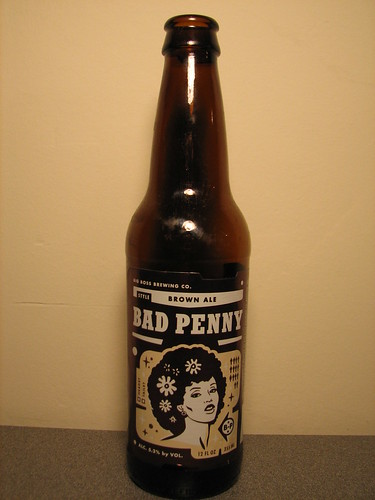
It pours very easily indeed, with a moderate brown tone about halfway between the Sprecher and the Goose Island. The head is minimal - maybe a quarter finger tops. Even that's gone after a few seconds, leaving only an off-white floaty foam. The nose is actually quite similar to the other two as well. It's a lovely mix of caramel, nuttiness - well, hell, you've heard this before. I'd say it's right in between the other two, aroma wise, although closer to the Sprecher and perhaps a bit more subdued.
But then there's the taste. Wow, it's not what I expected at all. What strikes me first is that it's surprisingly watery - not that the other two were ultra-creamy, but this one doesn't cover the mouth at all. That's not to say it's bad, though, because the taste makes up for it. It's strikingly bitter, much moreso than the others. Espresso grinds hit right up front and hold on tight while some malty, dark chocolate sweetness slides in behind them. Coffee remains the dominant flavor right up until the end, where the hops deliver an earthy little nibble and let things slide off. The aftertaste is surprisingly long, despite the watery texture: once again it's mostly bitter coffee and chocolate, with (maybe) some almonds to provide relief.
For a night out with the boys I'd choose one of the other two; this is just a little too striking to work for that role. But it's got its own charms, and - in the end - I think I prefer it. Certainly I admire it more as a beer. Bad Penny is like the Bruce Lee of English browns: it packs the maximum amount of force into the minimal effort. It's not a heavy beer, yet features a flavor profile I've found lacking in brews going well into the 8% range. I'm not sure how much use the world has for a beer like this, and I'm not sure whether I myself will ever have it again. But I'm glad it exists.
So: we've got a much narrower spread than I expected here, and not a bad beer in the lot. The Sprecher is boring but also unassuming, the workman of the group, while the Goose Island is pleasant and sweet (but not really properly brownalelich) and the Big Boss is a pint-sized monster (which is a little too watery and not great for pub nights). So: which one should you buy?
Honestly? None of these. Well, try them once for shits and giggles, sure. But if you want a fantastic brown ale, buy the Samuel Smith or the Naughty Goose or Dogfish Head's India Brown. And if you want a relatively cheap, delicious, mild, easily available example of the style for poker nights, the correct decision is in fact Ellie's Brown from Avery. (You can't miss it, it's got an adorable lab on the label.) That's a beer I'll get around to reviewing it one of these days. As it is, though, these three - good as they are - can't beat the standard.

Sprecher Pub Brown Ale
Grade: B-
Summary: A beginner's brown - not bad, just not all that much going on. Your dad will love it.
Goose Island Nut Brown Ale
Grade: B
Summary: Think of this as more of a sweet stout with English-style hops than a real brown. Still good, though.
Big Boss Bad Penny Brown Ale
Grade: B
Summary: The most creative and assertive beer here. Bittersweet, emphasis on the bitter. The wateriness really bugs me, though.
Subscribe to:
Posts (Atom)