Well, it's paper-writing week here at the U, and that means I don't have time to conjure up any deep thoughts or big comparative things. Instead I've decided (in brief form) to give the whole "imperial stout with coffee" thing another chance. This may or may not be a horrible idea.
The Lagunitas folks - who are, oddly enough, located about twenty miles north of Lagunitas, in Petaluma - may be from California, but they're fairly ubiquitous here in Illinois somehow. The Binnys website lists 18 of their beers, and I've yet to visit a reputable store without at least a few of their brews in stock. But aside from their IPA - which is almost architypically Californian, to a fault - I've never actually had any of these things. Tonight that changes. The goofy dog on the bottle has sold me, and so I'm trying out their December seasonal: the Cappucino Stout. So, here we go.
Well, it pours black (no surprise there), although when held up to a lamp I can detect some of the light still getting through. Funny enough, it's all ruby at the edges rather than brown. There's a cute little wheat-colored head, too, about a finger's worth, which then quickly dies away (this thing is north of 9% abv, after all). And the aroma - oh, happy days, they've done this one properly. Unlike the Breakfast Stout from Founders, which (you'll recall) I kind of hated, this one comes off as really well-balanced. The coffee is right out front, but kept under control by the addition of a thick ol' slab of sweet malts. Think of a slice of chocolate cake served with a cup of joe and you'll be close. And given a ton of agitation, I can actually detect some hops as well - which, for this kind of beer, is new to me. It's not a nose for the ages (I think I ultimately prefer the Kona Porter), but it's still an unexpectedly pleasant one.
The taste is quite a bit more varied, although it would be a stretch to say that anything about it is totally unexpected. At the front end and quite a ways beyond, this just comes across as a nice, extremely mild imperial stout: lots of bittersweet roasty malts and just a touch of dark fruit. As it moves towards the back of one's mouth, though, the coffee sweeps in like a German panzer brigade. Things get very bitter very fast as the bumble bean swarms over just about everything. And then, right after this, the hops try to push their way through - I can't really tell what sort they are, though, because they're clearly not making much headway against the onslaught. They do provide a lovely touch of dryness to the aftertaste, though, which is otherwise just coffee bitterness and a lingering chocolatey sweetness from the malts. As far as its texture, it comes across as rather thin for the style (not a motor oil, this) but still quite full-bodied and mouth-coating. It's pleasant, but not easy, to drink: you could easily spend a few hours on one bottle.
Bottom line? I like it. It's not something I would drink every day and it still falls short of perfection here and there, but it's a fine beer all the same. It's a good one to split with a group of friends, really, as anyone but a seasoned veteran is going to have trouble finishing a full deuce-deuce of this stuff. It hasn't dethroned the Kona as my favorite coffee beer, but it adds new evidence against my assertion that the idea of such a thing is fundamentally misguided.
Grade: B+
Summary: The first imperial coffee stout I've ever had that actually works.
Tuesday, March 16, 2010


Sunday, March 7, 2010
Brown Ale Throwdown: Sprecher Pub Brown Ale, Goose Island Nut Brown Ale, and Big Boss Bad Penny Brown Ale
Yes, this is another one of those things where I pick three random representatives of a style and compare them. What can I say? I'm an academic, comparing approaches comes naturally. And heck, maybe more people will read the site if I can dig a minor niche for myself.
First up is the Pub Brown Ale from Sprecher, a very English-sounding beer that could not possibly look more German. It's a pub ale with a big fuckin' griffin on a shield on the (16oz) bottle design, which just seems wrong somehow. Don't be fooled, though, this thing comes from neither side of the channel. Instead, Sprecher hails from the decidedly less European Glendale, Wisconsin; there they make a number of beers and sodas. I've never tried the beers, but I've had a few of the sodas. I wasn't wowed by their orange soda or ginger ale, but their root beer is heavenly; it'll never top the one from Boylan, which is as complex and serious and magnificent as a psych rock show, but the Sprecher is its sweeter, easy-to-drink alternative whenever I'm feeling a little punk. It's this root beer, then, that encouraged me to hunt down one of their beers (once I found out that they made some).
Oh my, a twist-off cap. It's been a while since I've seen one of those.
Well, it pours rather lightly, with a nice coppery color (not quite brown, but who's complaining) and a one-finger cream head that quickly dies off. It looks like a dark ginger ale, really. The aroma is very promising indeed: not much in the way of hops, but there's plenty of pale malts cut through with caramel, sassafras, and a little bit of earthiness. It's not particularly complex, but it's pleasant enough.
Hm, the taste is in a solid B- territory. It's good stuff, it's the sort of thing I'd drink tons of during a night on the town - "pub ale" is exactly the right term. There's just no real sparkle, though. The front edge is a slightly pearlike sourness, which evolves into a nice soil-and-syrup sort of taste. It's basically your classic earthy/bready brown ale flavor profile. The hops, too, are pretty by-the-book, but they're way turned down even compared to the Bell's brown ale from a while back. Even the mouthfeel is light.
So, then: Sprecher went for simple and mild, and they achieved it. For what it is, then, this brew is pretty good, although I wish they'd been a bit more ambitious. It does strike me as a perfect beer for at least one thing, though: converting the people who've been drinking Pabst their whole lives. Think of this, then, as a beginner beer, not so much a rival to the masters as a (superior) substitute for Newcastle.
Onto the Goose Island Nut Brown, then, which I am on record as declaring not anywhere near as good as their Naughty Goose. It is cheaper and easier to come by, though, and that counts for something. Like all Goose Island brews (excepting the Christmas Ale), this is immaculately packaged in a lovely black-on-brown label. The boys with laptops deserve praise for this one. Also, I should note that I've been saving this bottle roughly since September, so it may be a bit old now.
Well, it pours quite a bit darker than the Sprecher; sort of an auburn, rather than a rust. The head's a tad bit less intense, somewhere just north of a half-finger - I'm chalking this up to the slightly stronger 5.3% ABV. The aroma is very sweet, even sweeter than the Sprecher, but also less detailed (if that's possible). I mainly get caramel, lots and lots of it, with a touch of English hops mixed in. When given some agitation it opens up a tad more, offering more of a coffee aroma; but really, if you're looking for complexity this isn't your beer.
With the taste, I'm feeling even more guilty for accusing the Sprecher of simplicity. This stuff is stupid simple. Most of the hops seem to come through in an initial bitter jab, after which there's nothing but thick milk chocolatey malts. The aftertaste is slightly more dry, but the rest of the time this stuff is shamelessly sugar-driven. And the texture is a bit heavier than the Sprecher as well, although by beer standards I'd still only call it medium-bodied.
I like this beer; it's sweet and kind of unassuming, like the shy kid in class. As a beer, on its own, I'd rank it above the Sprecher, but it also doesn't seem to me to be much of a brown ale. In a lot of ways this is much more comparable to a really mild porter or a sweet stout. Thus it runs into something like the same problem as the Flossmoor Pullman I reviewed last year: it's a good beer, but if I really wanted a brown ale I'd have to go elsewhere.
Last on my list is Bad Penny from Big Boss Brewing. This is another one I picked up from my trip east: these guys make their home in Raleigh, so good luck finding one of these suckers out in Chi-town. It's almost worth it entirely for the bottle alone, though, because it's fucking awesome. It's like they took a movie poster from 1972 featuring a sassy sister making eyes, and just drained all the colors out of it except brown. Yes, I know that doesn't sound appealing, but it works. It even has a bottled-on date: November '09. Well, then - the Goose Island was still okay, so hopefully the months of mellowing have done some good here as well.
It pours very easily indeed, with a moderate brown tone about halfway between the Sprecher and the Goose Island. The head is minimal - maybe a quarter finger tops. Even that's gone after a few seconds, leaving only an off-white floaty foam. The nose is actually quite similar to the other two as well. It's a lovely mix of caramel, nuttiness - well, hell, you've heard this before. I'd say it's right in between the other two, aroma wise, although closer to the Sprecher and perhaps a bit more subdued.
But then there's the taste. Wow, it's not what I expected at all. What strikes me first is that it's surprisingly watery - not that the other two were ultra-creamy, but this one doesn't cover the mouth at all. That's not to say it's bad, though, because the taste makes up for it. It's strikingly bitter, much moreso than the others. Espresso grinds hit right up front and hold on tight while some malty, dark chocolate sweetness slides in behind them. Coffee remains the dominant flavor right up until the end, where the hops deliver an earthy little nibble and let things slide off. The aftertaste is surprisingly long, despite the watery texture: once again it's mostly bitter coffee and chocolate, with (maybe) some almonds to provide relief.
For a night out with the boys I'd choose one of the other two; this is just a little too striking to work for that role. But it's got its own charms, and - in the end - I think I prefer it. Certainly I admire it more as a beer. Bad Penny is like the Bruce Lee of English browns: it packs the maximum amount of force into the minimal effort. It's not a heavy beer, yet features a flavor profile I've found lacking in brews going well into the 8% range. I'm not sure how much use the world has for a beer like this, and I'm not sure whether I myself will ever have it again. But I'm glad it exists.
So: we've got a much narrower spread than I expected here, and not a bad beer in the lot. The Sprecher is boring but also unassuming, the workman of the group, while the Goose Island is pleasant and sweet (but not really properly brownalelich) and the Big Boss is a pint-sized monster (which is a little too watery and not great for pub nights). So: which one should you buy?
Honestly? None of these. Well, try them once for shits and giggles, sure. But if you want a fantastic brown ale, buy the Samuel Smith or the Naughty Goose or Dogfish Head's India Brown. And if you want a relatively cheap, delicious, mild, easily available example of the style for poker nights, the correct decision is in fact Ellie's Brown from Avery. (You can't miss it, it's got an adorable lab on the label.) That's a beer I'll get around to reviewing it one of these days. As it is, though, these three - good as they are - can't beat the standard.
Sprecher Pub Brown Ale
Grade: B-
Summary: A beginner's brown - not bad, just not all that much going on. Your dad will love it.
Goose Island Nut Brown Ale
Grade: B
Summary: Think of this as more of a sweet stout with English-style hops than a real brown. Still good, though.
Big Boss Bad Penny Brown Ale
Grade: B
Summary: The most creative and assertive beer here. Bittersweet, emphasis on the bitter. The wateriness really bugs me, though.
First up is the Pub Brown Ale from Sprecher, a very English-sounding beer that could not possibly look more German. It's a pub ale with a big fuckin' griffin on a shield on the (16oz) bottle design, which just seems wrong somehow. Don't be fooled, though, this thing comes from neither side of the channel. Instead, Sprecher hails from the decidedly less European Glendale, Wisconsin; there they make a number of beers and sodas. I've never tried the beers, but I've had a few of the sodas. I wasn't wowed by their orange soda or ginger ale, but their root beer is heavenly; it'll never top the one from Boylan, which is as complex and serious and magnificent as a psych rock show, but the Sprecher is its sweeter, easy-to-drink alternative whenever I'm feeling a little punk. It's this root beer, then, that encouraged me to hunt down one of their beers (once I found out that they made some).

Oh my, a twist-off cap. It's been a while since I've seen one of those.
Well, it pours rather lightly, with a nice coppery color (not quite brown, but who's complaining) and a one-finger cream head that quickly dies off. It looks like a dark ginger ale, really. The aroma is very promising indeed: not much in the way of hops, but there's plenty of pale malts cut through with caramel, sassafras, and a little bit of earthiness. It's not particularly complex, but it's pleasant enough.
Hm, the taste is in a solid B- territory. It's good stuff, it's the sort of thing I'd drink tons of during a night on the town - "pub ale" is exactly the right term. There's just no real sparkle, though. The front edge is a slightly pearlike sourness, which evolves into a nice soil-and-syrup sort of taste. It's basically your classic earthy/bready brown ale flavor profile. The hops, too, are pretty by-the-book, but they're way turned down even compared to the Bell's brown ale from a while back. Even the mouthfeel is light.
So, then: Sprecher went for simple and mild, and they achieved it. For what it is, then, this brew is pretty good, although I wish they'd been a bit more ambitious. It does strike me as a perfect beer for at least one thing, though: converting the people who've been drinking Pabst their whole lives. Think of this, then, as a beginner beer, not so much a rival to the masters as a (superior) substitute for Newcastle.
Onto the Goose Island Nut Brown, then, which I am on record as declaring not anywhere near as good as their Naughty Goose. It is cheaper and easier to come by, though, and that counts for something. Like all Goose Island brews (excepting the Christmas Ale), this is immaculately packaged in a lovely black-on-brown label. The boys with laptops deserve praise for this one. Also, I should note that I've been saving this bottle roughly since September, so it may be a bit old now.

Well, it pours quite a bit darker than the Sprecher; sort of an auburn, rather than a rust. The head's a tad bit less intense, somewhere just north of a half-finger - I'm chalking this up to the slightly stronger 5.3% ABV. The aroma is very sweet, even sweeter than the Sprecher, but also less detailed (if that's possible). I mainly get caramel, lots and lots of it, with a touch of English hops mixed in. When given some agitation it opens up a tad more, offering more of a coffee aroma; but really, if you're looking for complexity this isn't your beer.
With the taste, I'm feeling even more guilty for accusing the Sprecher of simplicity. This stuff is stupid simple. Most of the hops seem to come through in an initial bitter jab, after which there's nothing but thick milk chocolatey malts. The aftertaste is slightly more dry, but the rest of the time this stuff is shamelessly sugar-driven. And the texture is a bit heavier than the Sprecher as well, although by beer standards I'd still only call it medium-bodied.
I like this beer; it's sweet and kind of unassuming, like the shy kid in class. As a beer, on its own, I'd rank it above the Sprecher, but it also doesn't seem to me to be much of a brown ale. In a lot of ways this is much more comparable to a really mild porter or a sweet stout. Thus it runs into something like the same problem as the Flossmoor Pullman I reviewed last year: it's a good beer, but if I really wanted a brown ale I'd have to go elsewhere.
Last on my list is Bad Penny from Big Boss Brewing. This is another one I picked up from my trip east: these guys make their home in Raleigh, so good luck finding one of these suckers out in Chi-town. It's almost worth it entirely for the bottle alone, though, because it's fucking awesome. It's like they took a movie poster from 1972 featuring a sassy sister making eyes, and just drained all the colors out of it except brown. Yes, I know that doesn't sound appealing, but it works. It even has a bottled-on date: November '09. Well, then - the Goose Island was still okay, so hopefully the months of mellowing have done some good here as well.
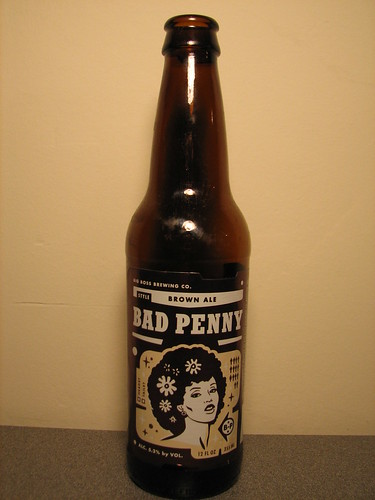
It pours very easily indeed, with a moderate brown tone about halfway between the Sprecher and the Goose Island. The head is minimal - maybe a quarter finger tops. Even that's gone after a few seconds, leaving only an off-white floaty foam. The nose is actually quite similar to the other two as well. It's a lovely mix of caramel, nuttiness - well, hell, you've heard this before. I'd say it's right in between the other two, aroma wise, although closer to the Sprecher and perhaps a bit more subdued.
But then there's the taste. Wow, it's not what I expected at all. What strikes me first is that it's surprisingly watery - not that the other two were ultra-creamy, but this one doesn't cover the mouth at all. That's not to say it's bad, though, because the taste makes up for it. It's strikingly bitter, much moreso than the others. Espresso grinds hit right up front and hold on tight while some malty, dark chocolate sweetness slides in behind them. Coffee remains the dominant flavor right up until the end, where the hops deliver an earthy little nibble and let things slide off. The aftertaste is surprisingly long, despite the watery texture: once again it's mostly bitter coffee and chocolate, with (maybe) some almonds to provide relief.
For a night out with the boys I'd choose one of the other two; this is just a little too striking to work for that role. But it's got its own charms, and - in the end - I think I prefer it. Certainly I admire it more as a beer. Bad Penny is like the Bruce Lee of English browns: it packs the maximum amount of force into the minimal effort. It's not a heavy beer, yet features a flavor profile I've found lacking in brews going well into the 8% range. I'm not sure how much use the world has for a beer like this, and I'm not sure whether I myself will ever have it again. But I'm glad it exists.
So: we've got a much narrower spread than I expected here, and not a bad beer in the lot. The Sprecher is boring but also unassuming, the workman of the group, while the Goose Island is pleasant and sweet (but not really properly brownalelich) and the Big Boss is a pint-sized monster (which is a little too watery and not great for pub nights). So: which one should you buy?
Honestly? None of these. Well, try them once for shits and giggles, sure. But if you want a fantastic brown ale, buy the Samuel Smith or the Naughty Goose or Dogfish Head's India Brown. And if you want a relatively cheap, delicious, mild, easily available example of the style for poker nights, the correct decision is in fact Ellie's Brown from Avery. (You can't miss it, it's got an adorable lab on the label.) That's a beer I'll get around to reviewing it one of these days. As it is, though, these three - good as they are - can't beat the standard.

Sprecher Pub Brown Ale
Grade: B-
Summary: A beginner's brown - not bad, just not all that much going on. Your dad will love it.
Goose Island Nut Brown Ale
Grade: B
Summary: Think of this as more of a sweet stout with English-style hops than a real brown. Still good, though.
Big Boss Bad Penny Brown Ale
Grade: B
Summary: The most creative and assertive beer here. Bittersweet, emphasis on the bitter. The wateriness really bugs me, though.
Saturday, February 27, 2010
Review: Ridgeway Foreign Export Stout
Ever since I aced the Lion Stout, I've had a nagging question. With the possible exception of Arcadia's Cocoa Loco - which is a somewhat different sort of beer - I'd never had an export stout before. And so, even though I was completely bowled over by the Sri Lanka slammer, there always remained a doubt about whether I really fell in love with the beer itself or with the style in general. Could it be that I'd just cornered the weakest member of a superior genus? Mightn't there be some other foreign stout out there which is even better? Thus, for a few months I've been keeping my eye out for something else of the same sort to compare the Lion with.
Needless to say I found one, and here it is: the Ridgeway Brewing Foreign Export Stout. It wasn't cheap - a mere 16.9 oz bottle went for $5.50, half the price of a whole sixer of Lions - but in the interest of science and my own curiosity I thought I'd give it a try. Unlike its South Asian cousin, though, this stuff hails direct from England. That gives it a "pedigree," I suppose, if that matters (it doesn't). And somehow it makes it seem even more ridiculous than the Lion, which (horrible photoshopping considered) is already pretty far up there. Despite how much I enjoy the culture, not to mention the beer, of England, there are some things that just send me giggling and keep me there. For starters, the Ridgeway here comes from somewhere called South Stoke, Oxfordshire. When I look it up Google Maps disagrees, and insists that No, South Stoke is actually in Berkshire, not Oxfordshire. So South Stoke either doesn't actually know where it is, or one of these sources is wrong. Frankly I'm happy to allow South Stoke to be wherever it likes, though, since both counties sound equally ridiculous to my American ears. They sound like the sort of places famous for a 12th century battle between some peasants and the esteemed Baron Doddingerton over taxation procedures in the Chipping Kilmister region. Everyone who lives there either drives a Bentley already or at least wants one - except in Oxford, maybe.
I kid, of course. They probably don't want them in Reading either.
But really, I kid because the beer itself encourages it. There's not much information to be found on Ridgeway Brewing, but the importers happily report that "Ridgeway Brewery is named for the ancient road... that meanders along a low escarpment across the high, rolling pastoral plain that is the southwest of England." Oh my. And it goes on: "The now patchy stone surface of the Ridgeway was laid by Britain’s oldest inhabitants – Druids and the like – thousands of years before the Romans turned up to build their own roadways. It is the oldest road in the British Isles and Europe, running nearly 100 miles, past that other ancient landmark, Stonehenge..." Okay, I'm stopping there, because if they pour any more of the Tradition thing on me I will probably start heaving. Yes, England is Old and your beer has history and Britishness and so on, we know.
On the outside, though, it really does have Britishness. I mean, blimey, just look at the bottle. It could only be more English if they'd somehow shaped the cap into the Spirit of Ecstasy. As a result, I'm expecting this stuff to taste like a mossy 9th century castle; whether that'll be a good or bad thing, I don't know. (But I'm eager to see.)
Well, here goes.
Nice - it pours a rich chocolate color, with a fine and proud three-finger tan head. I'm suddenly kicking myself for not having any Elgar on hand as accompaniment. The aroma is really lovely too - my closest point of reference is the Lion Stout, of course, but this is a bit more fruity and sweet, with way less cacao. Back behind the fruitiness is a mild toffee smell, intermixed with some earthy hops. It's a deep and musky aroma, really, like you might expect the Lake District to smell. It's not an amazing nose - it's actually a little too laid back, really - but it's pretty nice, and very British. Let's give it a sip or two.
Oh, that's scrumptious. Compared (again) to the Sri Lankan entry the taste is definitely several ranks sweeter, but it still maintains a bitter edge which (I assume) is characteristic of its species. There's some dark chocolate up front, which expands into a sweet but more espresso-like taste as it moves back. This is about where the fruitiness (prunes, mostly) from the nose comes in as well, although it's pretty well manhandled by the espresso. Then there's the hops, which arrive hauling nuts, soil, and that odd minty note I'm coming to associate with whole leaf hops. Finally, the aftertaste features whatever espresso has hung on from before plus the minty-soily hops. As far as texture goes, that too is like the Lion. Both are creamy but also quite carbonated, and these facts balance out nicely. It's a very easy beer to drink, especially for an eight percenter, but not so easy that you can unintentionally get yourself in trouble.
So by now you should already have some suspicion of the verdict. Is it a good beer? Yes, absolutely. I like it a lot, and if I could get a sixer of it around the $9 mark it would quickly go into my regular rotations. Hell, in a world without Sri Lanka I'd even be willing to drop six bucks on one every now and then. The trouble, obviously, is that as good as this is, a cheaper and even better brew is out there waiting to steal its blood pudding. As fine and English a beer as this is, the Lion Stout is somehow even moreso. It comes across as older, more earthy, more massive - and less user-friendly too, and by God better for it. Plus it's cheaper. Plus it's easier to find. So, basically on every level that matters the Lion is a better choice. Unless you really want a beer that's slightly sweeter, there's no reason to buy the Ridgeway. The English fought them in the brewing... and they lost.
So, to answer my question from before: yes, the Lion Stout really is that good. On the other hand, discovering and trying the Ridgeway has left me with a new puzzlement: why, exactly, did it take me this long to find another friggin' stout of this style? Why are so few breweries making them? I mean, just take a look at the beers available. Aside from the Lion, how many of these have you ever actually witnessed in the wild? Personally, I can recall seeing Fade to Black last year, and I know I spotted Reaper's entry somewhere or other. That's all. And this is still the case even when most of the sizeable microbreweries in the US (I suspect - haven't done the math) sell an imperial stout or two. The shelves are full of the damn things, in every variation anyone could want - 8% or 18% ABV, with chocolate, vanilla, and/or coffee thrown in, made with oatmeal or milk sugar, aged in barrels, whatever. Now, I love imperial stouts to a fault, but all of this still gets a bit stale after awhile. So why is it - with a earthier, mellower, possibly even more interesting, but equally powerful close relative of that style right on hand - that almost no one has bothered to switch things up? Why are there only a handful of American microbreweries selling these brews, leaving the Sri Lankans and the British as our main options?
I have to believe that I'm not the only person who adores this style. Other folks out there, perhaps, are also getting a bit bored with the parade of 40 proof Earl Grey-infused rum-barrel-aged hopheady stouts. So step up, brewers, it's time for something a little different. Give the Sri Lankans a scare or two.
Grade: B+
Summary: Like the Lion Stout, except sweeter and less interesting. And nearly three times as expensive.
Needless to say I found one, and here it is: the Ridgeway Brewing Foreign Export Stout. It wasn't cheap - a mere 16.9 oz bottle went for $5.50, half the price of a whole sixer of Lions - but in the interest of science and my own curiosity I thought I'd give it a try. Unlike its South Asian cousin, though, this stuff hails direct from England. That gives it a "pedigree," I suppose, if that matters (it doesn't). And somehow it makes it seem even more ridiculous than the Lion, which (horrible photoshopping considered) is already pretty far up there. Despite how much I enjoy the culture, not to mention the beer, of England, there are some things that just send me giggling and keep me there. For starters, the Ridgeway here comes from somewhere called South Stoke, Oxfordshire. When I look it up Google Maps disagrees, and insists that No, South Stoke is actually in Berkshire, not Oxfordshire. So South Stoke either doesn't actually know where it is, or one of these sources is wrong. Frankly I'm happy to allow South Stoke to be wherever it likes, though, since both counties sound equally ridiculous to my American ears. They sound like the sort of places famous for a 12th century battle between some peasants and the esteemed Baron Doddingerton over taxation procedures in the Chipping Kilmister region. Everyone who lives there either drives a Bentley already or at least wants one - except in Oxford, maybe.
I kid, of course. They probably don't want them in Reading either.
But really, I kid because the beer itself encourages it. There's not much information to be found on Ridgeway Brewing, but the importers happily report that "Ridgeway Brewery is named for the ancient road... that meanders along a low escarpment across the high, rolling pastoral plain that is the southwest of England." Oh my. And it goes on: "The now patchy stone surface of the Ridgeway was laid by Britain’s oldest inhabitants – Druids and the like – thousands of years before the Romans turned up to build their own roadways. It is the oldest road in the British Isles and Europe, running nearly 100 miles, past that other ancient landmark, Stonehenge..." Okay, I'm stopping there, because if they pour any more of the Tradition thing on me I will probably start heaving. Yes, England is Old and your beer has history and Britishness and so on, we know.
On the outside, though, it really does have Britishness. I mean, blimey, just look at the bottle. It could only be more English if they'd somehow shaped the cap into the Spirit of Ecstasy. As a result, I'm expecting this stuff to taste like a mossy 9th century castle; whether that'll be a good or bad thing, I don't know. (But I'm eager to see.)

Well, here goes.
Nice - it pours a rich chocolate color, with a fine and proud three-finger tan head. I'm suddenly kicking myself for not having any Elgar on hand as accompaniment. The aroma is really lovely too - my closest point of reference is the Lion Stout, of course, but this is a bit more fruity and sweet, with way less cacao. Back behind the fruitiness is a mild toffee smell, intermixed with some earthy hops. It's a deep and musky aroma, really, like you might expect the Lake District to smell. It's not an amazing nose - it's actually a little too laid back, really - but it's pretty nice, and very British. Let's give it a sip or two.
Oh, that's scrumptious. Compared (again) to the Sri Lankan entry the taste is definitely several ranks sweeter, but it still maintains a bitter edge which (I assume) is characteristic of its species. There's some dark chocolate up front, which expands into a sweet but more espresso-like taste as it moves back. This is about where the fruitiness (prunes, mostly) from the nose comes in as well, although it's pretty well manhandled by the espresso. Then there's the hops, which arrive hauling nuts, soil, and that odd minty note I'm coming to associate with whole leaf hops. Finally, the aftertaste features whatever espresso has hung on from before plus the minty-soily hops. As far as texture goes, that too is like the Lion. Both are creamy but also quite carbonated, and these facts balance out nicely. It's a very easy beer to drink, especially for an eight percenter, but not so easy that you can unintentionally get yourself in trouble.
So by now you should already have some suspicion of the verdict. Is it a good beer? Yes, absolutely. I like it a lot, and if I could get a sixer of it around the $9 mark it would quickly go into my regular rotations. Hell, in a world without Sri Lanka I'd even be willing to drop six bucks on one every now and then. The trouble, obviously, is that as good as this is, a cheaper and even better brew is out there waiting to steal its blood pudding. As fine and English a beer as this is, the Lion Stout is somehow even moreso. It comes across as older, more earthy, more massive - and less user-friendly too, and by God better for it. Plus it's cheaper. Plus it's easier to find. So, basically on every level that matters the Lion is a better choice. Unless you really want a beer that's slightly sweeter, there's no reason to buy the Ridgeway. The English fought them in the brewing... and they lost.
So, to answer my question from before: yes, the Lion Stout really is that good. On the other hand, discovering and trying the Ridgeway has left me with a new puzzlement: why, exactly, did it take me this long to find another friggin' stout of this style? Why are so few breweries making them? I mean, just take a look at the beers available. Aside from the Lion, how many of these have you ever actually witnessed in the wild? Personally, I can recall seeing Fade to Black last year, and I know I spotted Reaper's entry somewhere or other. That's all. And this is still the case even when most of the sizeable microbreweries in the US (I suspect - haven't done the math) sell an imperial stout or two. The shelves are full of the damn things, in every variation anyone could want - 8% or 18% ABV, with chocolate, vanilla, and/or coffee thrown in, made with oatmeal or milk sugar, aged in barrels, whatever. Now, I love imperial stouts to a fault, but all of this still gets a bit stale after awhile. So why is it - with a earthier, mellower, possibly even more interesting, but equally powerful close relative of that style right on hand - that almost no one has bothered to switch things up? Why are there only a handful of American microbreweries selling these brews, leaving the Sri Lankans and the British as our main options?
I have to believe that I'm not the only person who adores this style. Other folks out there, perhaps, are also getting a bit bored with the parade of 40 proof Earl Grey-infused rum-barrel-aged hopheady stouts. So step up, brewers, it's time for something a little different. Give the Sri Lankans a scare or two.
Grade: B+
Summary: Like the Lion Stout, except sweeter and less interesting. And nearly three times as expensive.
Thursday, February 25, 2010
Vacation Roundup: Starr Hill The Love and Dark Starr
Charlottesville is probably my favorite town (well, city) in Virginia. Admittedly, this probably isn't saying much. Everywhere around DC is more or less a suburban office park nightmare, absorbing all the petty malice and mutual unconcern radiating off of I-495 - the notorious Capital Beltway, the most hateful road on the east coast and an entity which feeds from the souls of all existing within many miles of it. The Virginia Beach area is a Navy town and a tourist trap, making me feel doubly out of place. Roanoke is located in the mountains (a plus), but is otherwise a bit boring somehow. Richmond is, well, hopeless. I'm tempted to pick Luray (foothill heaven, and mere miles away from Skyline Drive and the astonishing US-211, i.e. two of the best roads in Virginia), or maybe Leesburg or Williamsburg (for the simple joy of the colonial architecture). But on points, it's gotta be Charlottesville. It does the historic town thing almost as well, it's close to the mountains, it's actually got some culture, and they even like to drink a little. But this raises a question: can they brew a good beer?
To find out, I bought a pair of brews from Starr Hill while I was out east a few months back. The Starr Hill brewery is actually located a few miles west of Charlottesville (in Crozet), and they're surprisingly ubiquitous in the mideast states (I found some sixers of these as far down as North Carolina). I've got a The Love, which is a hefeweizen with a silly name, and a Dark Starr, which is a dry stout. So, let's start with the wheatbeer first.
Here's the first bit of news: the label is pink. At their site for the beer Starr Hill boasts that this stuff is made from an award-winning German yeast handed over by a friend. Someone "shared the love" with them, get it? Yes, yes, we see the pun, fine. But I would have titled the beer "Starr Hill Thank You," made the cover a big thumbs up to Germany, and saved myself the trouble. And I certainly wouldn't have made the label pink. Gah.
Pour it into a glass, though, and things start to get better: it's got a lovely cloudy-gold look, pretty much standard for the style, with a nice yeasty two-finger white head. And it's a sticky head too: with an ABV of only 4.6% (on the low side by wheatbeer standards), there's really not much to pull it back down. The aroma is very lemon-limey, with a hit of yeast further back; agitate it a bit and it shifts more in a banana direction. It's quite a simple aroma for a weiss, but there's nothing that's turning me off so far.
The taste carries through on the promise of the lemony aroma - it's a kind of yeasty lemonade, although obviously without the sweetness. Right up front is a pleasant tarty tang, which maintains itself right up to the end. Around there a wheaty taste butts in, along with some cloves and cilantro. No real hoppiness here, although I wasn't expecting it. The aftertaste, for the most part, is just more citrusy goodness. And... frankly, I'm struggling to think of anything more to say. Body's pretty light. No sense of the alcohol at all. It's a very refreshing taste, as these sorts of things tend to be, but there's also nothing at all to set this apart from the crowd.
Well, I didn't taste much love to be honest, but it's not bad. There's only one way to describe The Love: it is a Hefeweizen. And that means: if you like hefeweizens, you will think this one's pretty okay. It will do just fine by you, and you will immediately forget it exists after you finish drinking it. Such is its fate.
Now, onto the Dark Starr Stout. Unlike the self-consciously goofy The Love, this beer's a little more serious. The bottle's all murdered out, looking scary and muscular like a 1974 Challenger. Check the stats, though, and you discover that this black-bottled terror is actually a bit of a softie: it's 4.81% ABV, only a touch above Guinness and Murphy's (heck, the Black Hawk - still my go-to dry stout - is well into the low 5% range). So I'm expecting this to be more of a pub beer, more of a filling but unobtrusive bit of black matter that'll provide just the slightest lubricant for an evening with the boys.
Oh. Man, that's not what this is at all.
It's black, to be sure; it's got a medium viscosity and a half-finger head, to be sure; but this isn't a good old fashioned Irish stout. The aroma is, well, not what I expected at all. The strangest thing to the aroma is a strong, almost meaty quality, as if there's some grilled pork in there or something. It's not something I've encountered before, and I don't really dig it. Beyond that there's some coffee, lots of roasted malts, and an odd sourness that I can't pin down.
And the taste? Err, well, it's dry, give it that much. But beyond that everything's gone wrong. For starters, it's incredibly watery. The sourness from the aroma is also here (not something I really want in a stout). And then there's the worst part: from the very first sip one is inundated with a consistently cloying, smokey, ashy taste. Way back there, behind the wall of smoke, I can tell there are some good traditional stouty flavors, but there's really no digging them out. The aftertaste is indeed dry, but that's not enough to chase away the unpleasant smoky-sourness
If ever one needed a textbook example of how not to use roasted malts, this would be it. I suppose it's unique, sure, but it's not good, especially if you plan on drinking a whole bottle. (Starr Hill touts this as their "most awarded beer." I can only assume the judges all just did the sip-and-spit thing, because there's no way they would have medal'd this stuff if they'd had to suck down 12 ounces of it.) It's a watery, burned-out answer to a question no one asked. If you really want a smoky beer, try an Aecht Schlenkerla Märzen; if you really want a dry stout from Virginia, try to broaden your horizons.
So: Charlottesville. Nice town, and they make not-so-great stouts and also a Hefeweizen. I'll see if I can learn more on my next trip, I guess.
Starr Hill The Love
Grade: B-
Summary: It meets hefeweizen expectations.
Starr Hill Dark Starr
Grade: C-
Summary: Not so much a dry stout as a watery, ashy mess. Unique enough for the curious, but unpleasant to finish.
To find out, I bought a pair of brews from Starr Hill while I was out east a few months back. The Starr Hill brewery is actually located a few miles west of Charlottesville (in Crozet), and they're surprisingly ubiquitous in the mideast states (I found some sixers of these as far down as North Carolina). I've got a The Love, which is a hefeweizen with a silly name, and a Dark Starr, which is a dry stout. So, let's start with the wheatbeer first.
Here's the first bit of news: the label is pink. At their site for the beer Starr Hill boasts that this stuff is made from an award-winning German yeast handed over by a friend. Someone "shared the love" with them, get it? Yes, yes, we see the pun, fine. But I would have titled the beer "Starr Hill Thank You," made the cover a big thumbs up to Germany, and saved myself the trouble. And I certainly wouldn't have made the label pink. Gah.

Pour it into a glass, though, and things start to get better: it's got a lovely cloudy-gold look, pretty much standard for the style, with a nice yeasty two-finger white head. And it's a sticky head too: with an ABV of only 4.6% (on the low side by wheatbeer standards), there's really not much to pull it back down. The aroma is very lemon-limey, with a hit of yeast further back; agitate it a bit and it shifts more in a banana direction. It's quite a simple aroma for a weiss, but there's nothing that's turning me off so far.
The taste carries through on the promise of the lemony aroma - it's a kind of yeasty lemonade, although obviously without the sweetness. Right up front is a pleasant tarty tang, which maintains itself right up to the end. Around there a wheaty taste butts in, along with some cloves and cilantro. No real hoppiness here, although I wasn't expecting it. The aftertaste, for the most part, is just more citrusy goodness. And... frankly, I'm struggling to think of anything more to say. Body's pretty light. No sense of the alcohol at all. It's a very refreshing taste, as these sorts of things tend to be, but there's also nothing at all to set this apart from the crowd.
Well, I didn't taste much love to be honest, but it's not bad. There's only one way to describe The Love: it is a Hefeweizen. And that means: if you like hefeweizens, you will think this one's pretty okay. It will do just fine by you, and you will immediately forget it exists after you finish drinking it. Such is its fate.
Now, onto the Dark Starr Stout. Unlike the self-consciously goofy The Love, this beer's a little more serious. The bottle's all murdered out, looking scary and muscular like a 1974 Challenger. Check the stats, though, and you discover that this black-bottled terror is actually a bit of a softie: it's 4.81% ABV, only a touch above Guinness and Murphy's (heck, the Black Hawk - still my go-to dry stout - is well into the low 5% range). So I'm expecting this to be more of a pub beer, more of a filling but unobtrusive bit of black matter that'll provide just the slightest lubricant for an evening with the boys.

Oh. Man, that's not what this is at all.
It's black, to be sure; it's got a medium viscosity and a half-finger head, to be sure; but this isn't a good old fashioned Irish stout. The aroma is, well, not what I expected at all. The strangest thing to the aroma is a strong, almost meaty quality, as if there's some grilled pork in there or something. It's not something I've encountered before, and I don't really dig it. Beyond that there's some coffee, lots of roasted malts, and an odd sourness that I can't pin down.
And the taste? Err, well, it's dry, give it that much. But beyond that everything's gone wrong. For starters, it's incredibly watery. The sourness from the aroma is also here (not something I really want in a stout). And then there's the worst part: from the very first sip one is inundated with a consistently cloying, smokey, ashy taste. Way back there, behind the wall of smoke, I can tell there are some good traditional stouty flavors, but there's really no digging them out. The aftertaste is indeed dry, but that's not enough to chase away the unpleasant smoky-sourness
If ever one needed a textbook example of how not to use roasted malts, this would be it. I suppose it's unique, sure, but it's not good, especially if you plan on drinking a whole bottle. (Starr Hill touts this as their "most awarded beer." I can only assume the judges all just did the sip-and-spit thing, because there's no way they would have medal'd this stuff if they'd had to suck down 12 ounces of it.) It's a watery, burned-out answer to a question no one asked. If you really want a smoky beer, try an Aecht Schlenkerla Märzen; if you really want a dry stout from Virginia, try to broaden your horizons.
So: Charlottesville. Nice town, and they make not-so-great stouts and also a Hefeweizen. I'll see if I can learn more on my next trip, I guess.
Starr Hill The Love
Grade: B-
Summary: It meets hefeweizen expectations.
Starr Hill Dark Starr
Grade: C-
Summary: Not so much a dry stout as a watery, ashy mess. Unique enough for the curious, but unpleasant to finish.
Saturday, February 20, 2010
Review: Dogfish Head Punkin Ale
I'd like to talk for a bit about impossibility.
"Impossible" is, philosophically, a translation of the Greek adunatos. To be "dunatos" in the typical sense is to be strong, i.e. fit and able-bodied; in an extended sense it means to have a capacity, to be able to do something. Dunamis is "power," but not power in the general sense. It's always a power of a very specific sort: the power of a shoemaker to produce shoes, the power of a seed to grow into a tree, the power of 3 to become 9 when squared. But that same 3 cannot become 4 or 16 when squared, and to this extent it is adunatos - incapable. It cannot support the possibility, it cannot bear it. The seed too, will not support ever being-at-work growing into a castle or a dinosaur; the situation, as it were, cannot be borne by the entity. And when Aristotle famously states the single most basic principle (archē) of philosophy, he uses this very term: "To gar auto ama huparchein te kai mē huparchein adunaton tōi autō kai kata to auto." (1005b) This is a difficult and controversial passage to translate ("huparchein" is extremely ambiguous), but I submit: "for the same thing is incapable of both being and not being in a single moment, for itself and according to itself." But despite this being Aristotle's "most firm principle," I think we have to consider it as grounded in something even more basic - namely, the very concept of dunamis and the dunaton developed in Metaphysics IX. I won't try to deal with that discussion here, but suffice it to say that I consider it probably the single most important text in the history of Western philosophy.
Aristotle's statement has come down to us, of course, as the principle of noncontradiction, and although there have been subtle and important shifts in the content (many of which would have puzzled Aristotle, I think) it retains its status as something fundamental. Capacity has become possibility - now defining less what entities can do, and more whether and which entities can be at all. And the principle of noncontradiction quite often defines the space of possibility as such - "whatever is self-identical is able to exist." It usually defines the space for logical possibility, at least, i.e. it defines which propositions may concievably be true and which not. But of course, over the years philosophers have added additional limits to possibilities. Things may be impossible as willed by God, impossible by reason of a lacking cause, impossible by natural law, and (in Kant) impossible by the conditions of possible experience.
Let us consider this last one, what Kant calls "The Highest Principle of All Synthetic Judgments": "every object stands under the necessary conditions of synthetic unity of the manifold of intuition in a possible experience." (A158 B197) Since the project of the Critique of Pure Reason is famously to establish how it is possible that we know and experience objects at all - which turns out to amount to the question of how a priori synthesis is possible - then then this little stretch of text is fundamental to that project. The conditions of experience - whether that experience be concrete or an imagination of sorts - determines what and whether an object of experience can be. It's the chief work of the Transcendental Doctrine of Elements to determine what those conditions are. By doing so, one can precisely establish the limits of experiential as well as epistemic possibility.
Here one runs into a problem, especially obvious in Kant but (I think) probably common to everyone who attempts to determine the limits of the possible. How is it possible to establish what is possible? So far as I can tell, there are two available roads (Kant uses both). The first is to set down a law a priori from which one can derive various consequences. The second is the process that we now call "transcendental argument."
A "transcendental argument" is not, strictly speaking, an argument. It does not present premises from which one can derive consequences - or, at any rate, if it were then it couldn't do the sort of work Kant needs it to do. This "argument" consists rather in a curious form of projection, of the fantasy of a certain sort of experience. (I suspect it is finally no different in kind from what Husserl names as "eidetic variation.") We project ourselves into an experience and, as it were, attempt to determine the limits of the experience itself. We ask ourselves whether it is conceivable to experience in certain ways at all. The "argument" of Kant's second analogy, for example, does not conclude that experience is bound by the laws of causality because of some feature of the concepts involved. The point, brutely put, is: "Look, you can be skeptical all you want, but imagine yourself in a real situation watching the manifold sequence of events involved in billiard balls hitting each other. Now try to imagine that there is no succession at all. Not that the individual perceptions occur in a new order, but that there is simply no order. There is nothing wrong with the mere concept of this, but does it still make sense to think of these as events at all? Can we meaningfully think of perceptions without succession as experience?" The answer is supposed to be "no" - thus we admit temporal succession, i.e. causality, as a necessary condition for experience.
But if this is the method of transcendental argument, then it is open to an extremely simple criticism. In the end, there are quite a lot of things which we fail to "conceive" before the fact - falling in love, drinking an extraordinary Scotch, witnessing the collapse of Lehman Brothers - but this does not keep them from happening. And they do happen; they throw themselves at us despite our never seeing them in advance. And if impossibility here is tantamount to inconceivability, then one must conclude that the impossible happens every day. (One might establish "gradations" of impossibility, but that would be all.) Of course, one could counter that the inconceivability of non-successive experience is not the same as the inconceivability of a financial disaster. One might argue that there is a difference between what has not been thought by one person, or even by anyone, and what cannot be thought at all. But it is utterly questionable whether this is a distinction any of us could legitimately make. After all, it is me who participates in transcendental argumentation, not some grand overmind: if I cannot conceive something, I also cannot establish in advance which sort of non-conceiving I have run into. If we are to set down this distinction nevertheless, then we must turn to another method. We must take it as a principle.
There is, so far as I am aware, no serious criticism of the first Critique more common than: "Where exactly does the Table of Judgments come from??" That is, where does Kant get the source from which the deduction of the basic categories of experience is supposed to proceed? It's a very good criticism; Kant himself admits that he does not know (it's the mark of an uncommonly honest philosopher that he does this). In the end he simply lifts it from the tradition he's supposed to be critiquing and, thus, dogmatically takes the whole basis for the Transcendental Logic for granted. And I suspect one runs into the same question anytime one wishes to establish a law that will decide, once and for all, what is and is not possible. One can always just turn the quid juris back against the very thing that's supposed to establish the right in the first place. To be sure, dogmatic presuppositions of this sort can do quite a lot of work and they can be quite plausible, but ultimately they shall remain somewhat unsatisfactory. They will always be questionable, even if one has never heard of the epochē or Husserl's principle of principles.
Let us go back and reconsider Aristotle. His archē reads, once again: "The same thing is incapable of both being and not being in a single moment, for itself and according to itself." Is this a principle, asserted dogmatically? Initially it may look that way, but I think this is inaccurate. For one thing, Aristotle musters considerable phenomenological evidence to support his case, especially in Metaphysics IV.4. But it can also be seen simply from another line that closely follows the principle and, as it were, anchors it: "adunaton gar hontinoun tauton hupolambanein einai kai mē einai," "for it is unbearable to believe that the same thing can be and not be." Aristotle's entire proof of the principle amounts to demonstrating that this cannot be "believed," i.e. that one just cannot experience matters in that way. It thus amounts to a kind of transcendental argument - the same sort as before. But if that's so, then it is ultimately vulnerable to precisely the same criticisms as any other such "argument." Even noncontradiction, then, must run up against our inability to firmly draw a line between the absolutely impossible and the individually (or even universally) inconceivable.
Don't misunderstand me: I am not saying that everything is possible. This is exactly the reverse of my conclusion. There are possibilities, and there "are" impossibilities. This line is drawn by what is thinkable. But if I erase the second line between inconceivability and absolute impossibility, I do so not only on the basis of a good argument which is, however, entirely negative. I also do so because there are important, positive phenomenological consequences. The extraordinary thing is this: if impossibility is indeed tantamount to the unthinkable, the inconceivable - i.e., if we cannot justify any distinction between the two - then we will indeed experience the impossible to the same extent that we experience the unexpected. Perhaps this only happens for a moment, or even less; perhaps in the same instant that the impossible happens it retroactively inscribes itself into the field of the possible so that, as in Kant, there is an unbroken succession of reason. Nevertheless the impossible does happen. If that seems outrageous to common sense, I agree, but I think it's phenomenologically accurate nevertheless. The real work is to try to describe exactly what happens in those moments - as it were, to articulate how it is that the impossible gives itself to us. But that's work for a whole lifetime.
Now, all of this brings me to Dogfish Head.
If impossibility has a friend in the world of brewing, that friend is surely Dogfish Head. As a brewery, it's experimental to a fault and beyond. They are constantly pushing the edge on what we think beer can be, and depending on your taste this can be a good or a bad thing. Me, I love them. I love them more than I love other breweries that, overall, make better beer, precisely because I know these guys will always surprise me. Beer made with raisins and peaches? SURE. A stout pushing 40 proof? WHY NOT. A recreation of something we scraped out of 2700 year old steins? DAMN RIGHT. One gets the sense that they won't be happy until they break out of beermaking entirely and end up in some other kind of medium. The results probably fail more often than they succeed - but they're also never boring.
This here is Punkin, a brown ale brewed with pumpkins which is apparently the first beer they ever made. From the website: "Punkin Ale made it's debut as it claimed First Prize in the 1994 Punkin Chunkin Recipe Conest - yes, that was a full 6 months before we even opened our doors for business." As such, it seems like a good subject for a first review of their catalog. I'd almost forgotten that I had one of these until yesterday; it's getting on a little agewise (they brew this stuff at the beginning of fall), but I'm looking forward to trying it. My only other experience with a pumpkin ale is the Ichabod Ale by New Holland, which I found decidedly "meh."
Well, it pours a funky orange-amber with a finger's worth of fairly thin white head (no lacing from this sucker - that stuff is strictly carbonation). Good God, I can smell the aroma from here. And "pumpkin" isn't the first thing that comes to mind, although as I stick my head in - whew! - I can certainly detect it. The initial impression is more of a sharp, penetrating fruitiness, mellowed out by good old fashioned ale malts. It's like a pale ale that's been shot through with a cross-section of supermarket produce. And I can also detect a goodly bit of spice in here - mainly nutmeg, although the bottle informs me that there's also allspice and cinnamon. This is definitely not something I've smelled before - I'm not sure if I like it, but it's surely unique.
Wow, that's different... hmmm. Hmmmmm.
Well, first off, the beer is quite a bit thinner than I thought it would be. I was expecting more of the usual touch of brown ale creaminess, but it's actually rather watery. Second off, it's surprisingly boozy. This brew is a seven-percenter, which is high for a "brown ale" but pretty mild by my standards. The problem is that it doesn't hide it at all. Subtlety is not this beer's strong suit; if you're trying to get someone drunk on the sly, this is not the beer to do it with.
As for the taste itself, it's a bit of a rollercoaster. A fun one, no doubt, but one that will end in seasickness for a few among the riders. I admire this taste, but I don't think I like it. On the front end it seems like any other amber or pale ale - you get a sweet kiss of malt with a little bit of sour thrown in. Towards the middle things start to get weird. The usual caramel flavors are there, but a massive streak of herby dry bitterness rides right on top of them. That would be the spices, I expect. By the swallow said spices have taken over completely - there's a yeasty snap in the aftertaste, and then all that's left is a rather vegetable-like bitter mouth coating. Funny as hell, I don't actually taste any pumpkin here. I taste your regular run-of-the-mill ale malts, your crazy spice rack contents, and that's about all. No real fruit character through the entire thing.
If you like, you can divide Dogfish Head beers into four categories. The first is the standards; the second is the beer styles that they haven't drastically fucked with, but maybe tried to improve; the third is the radical experiments that succeeded; the fourth is the experiments that failed, but remain interesting. Punkin falls squarely into the fourth category - more of a Raison D'Etre than an Immort Ale or an India Brown. It's special enough to try once, but now that I've done it I don't think I'd bother a second time.
So, not a great beer, then. Is it going to put me off of Dogfish Head? Hell no. If I want a good solid beer that's going to coddle me for the night, well, there's lots of other breweries I can turn to. But if I want something that gives me a glimpse of impossibility - well, by that measure they're the best in the business.
Grade: C+
Summary: A very boozy amber ale and some fall spices meet up and cohabitate. Not very good, but try it anyways.
"Impossible" is, philosophically, a translation of the Greek adunatos. To be "dunatos" in the typical sense is to be strong, i.e. fit and able-bodied; in an extended sense it means to have a capacity, to be able to do something. Dunamis is "power," but not power in the general sense. It's always a power of a very specific sort: the power of a shoemaker to produce shoes, the power of a seed to grow into a tree, the power of 3 to become 9 when squared. But that same 3 cannot become 4 or 16 when squared, and to this extent it is adunatos - incapable. It cannot support the possibility, it cannot bear it. The seed too, will not support ever being-at-work growing into a castle or a dinosaur; the situation, as it were, cannot be borne by the entity. And when Aristotle famously states the single most basic principle (archē) of philosophy, he uses this very term: "To gar auto ama huparchein te kai mē huparchein adunaton tōi autō kai kata to auto." (1005b) This is a difficult and controversial passage to translate ("huparchein" is extremely ambiguous), but I submit: "for the same thing is incapable of both being and not being in a single moment, for itself and according to itself." But despite this being Aristotle's "most firm principle," I think we have to consider it as grounded in something even more basic - namely, the very concept of dunamis and the dunaton developed in Metaphysics IX. I won't try to deal with that discussion here, but suffice it to say that I consider it probably the single most important text in the history of Western philosophy.
Aristotle's statement has come down to us, of course, as the principle of noncontradiction, and although there have been subtle and important shifts in the content (many of which would have puzzled Aristotle, I think) it retains its status as something fundamental. Capacity has become possibility - now defining less what entities can do, and more whether and which entities can be at all. And the principle of noncontradiction quite often defines the space of possibility as such - "whatever is self-identical is able to exist." It usually defines the space for logical possibility, at least, i.e. it defines which propositions may concievably be true and which not. But of course, over the years philosophers have added additional limits to possibilities. Things may be impossible as willed by God, impossible by reason of a lacking cause, impossible by natural law, and (in Kant) impossible by the conditions of possible experience.
Let us consider this last one, what Kant calls "The Highest Principle of All Synthetic Judgments": "every object stands under the necessary conditions of synthetic unity of the manifold of intuition in a possible experience." (A158 B197) Since the project of the Critique of Pure Reason is famously to establish how it is possible that we know and experience objects at all - which turns out to amount to the question of how a priori synthesis is possible - then then this little stretch of text is fundamental to that project. The conditions of experience - whether that experience be concrete or an imagination of sorts - determines what and whether an object of experience can be. It's the chief work of the Transcendental Doctrine of Elements to determine what those conditions are. By doing so, one can precisely establish the limits of experiential as well as epistemic possibility.
Here one runs into a problem, especially obvious in Kant but (I think) probably common to everyone who attempts to determine the limits of the possible. How is it possible to establish what is possible? So far as I can tell, there are two available roads (Kant uses both). The first is to set down a law a priori from which one can derive various consequences. The second is the process that we now call "transcendental argument."
A "transcendental argument" is not, strictly speaking, an argument. It does not present premises from which one can derive consequences - or, at any rate, if it were then it couldn't do the sort of work Kant needs it to do. This "argument" consists rather in a curious form of projection, of the fantasy of a certain sort of experience. (I suspect it is finally no different in kind from what Husserl names as "eidetic variation.") We project ourselves into an experience and, as it were, attempt to determine the limits of the experience itself. We ask ourselves whether it is conceivable to experience in certain ways at all. The "argument" of Kant's second analogy, for example, does not conclude that experience is bound by the laws of causality because of some feature of the concepts involved. The point, brutely put, is: "Look, you can be skeptical all you want, but imagine yourself in a real situation watching the manifold sequence of events involved in billiard balls hitting each other. Now try to imagine that there is no succession at all. Not that the individual perceptions occur in a new order, but that there is simply no order. There is nothing wrong with the mere concept of this, but does it still make sense to think of these as events at all? Can we meaningfully think of perceptions without succession as experience?" The answer is supposed to be "no" - thus we admit temporal succession, i.e. causality, as a necessary condition for experience.
But if this is the method of transcendental argument, then it is open to an extremely simple criticism. In the end, there are quite a lot of things which we fail to "conceive" before the fact - falling in love, drinking an extraordinary Scotch, witnessing the collapse of Lehman Brothers - but this does not keep them from happening. And they do happen; they throw themselves at us despite our never seeing them in advance. And if impossibility here is tantamount to inconceivability, then one must conclude that the impossible happens every day. (One might establish "gradations" of impossibility, but that would be all.) Of course, one could counter that the inconceivability of non-successive experience is not the same as the inconceivability of a financial disaster. One might argue that there is a difference between what has not been thought by one person, or even by anyone, and what cannot be thought at all. But it is utterly questionable whether this is a distinction any of us could legitimately make. After all, it is me who participates in transcendental argumentation, not some grand overmind: if I cannot conceive something, I also cannot establish in advance which sort of non-conceiving I have run into. If we are to set down this distinction nevertheless, then we must turn to another method. We must take it as a principle.
There is, so far as I am aware, no serious criticism of the first Critique more common than: "Where exactly does the Table of Judgments come from??" That is, where does Kant get the source from which the deduction of the basic categories of experience is supposed to proceed? It's a very good criticism; Kant himself admits that he does not know (it's the mark of an uncommonly honest philosopher that he does this). In the end he simply lifts it from the tradition he's supposed to be critiquing and, thus, dogmatically takes the whole basis for the Transcendental Logic for granted. And I suspect one runs into the same question anytime one wishes to establish a law that will decide, once and for all, what is and is not possible. One can always just turn the quid juris back against the very thing that's supposed to establish the right in the first place. To be sure, dogmatic presuppositions of this sort can do quite a lot of work and they can be quite plausible, but ultimately they shall remain somewhat unsatisfactory. They will always be questionable, even if one has never heard of the epochē or Husserl's principle of principles.
Let us go back and reconsider Aristotle. His archē reads, once again: "The same thing is incapable of both being and not being in a single moment, for itself and according to itself." Is this a principle, asserted dogmatically? Initially it may look that way, but I think this is inaccurate. For one thing, Aristotle musters considerable phenomenological evidence to support his case, especially in Metaphysics IV.4. But it can also be seen simply from another line that closely follows the principle and, as it were, anchors it: "adunaton gar hontinoun tauton hupolambanein einai kai mē einai," "for it is unbearable to believe that the same thing can be and not be." Aristotle's entire proof of the principle amounts to demonstrating that this cannot be "believed," i.e. that one just cannot experience matters in that way. It thus amounts to a kind of transcendental argument - the same sort as before. But if that's so, then it is ultimately vulnerable to precisely the same criticisms as any other such "argument." Even noncontradiction, then, must run up against our inability to firmly draw a line between the absolutely impossible and the individually (or even universally) inconceivable.
Don't misunderstand me: I am not saying that everything is possible. This is exactly the reverse of my conclusion. There are possibilities, and there "are" impossibilities. This line is drawn by what is thinkable. But if I erase the second line between inconceivability and absolute impossibility, I do so not only on the basis of a good argument which is, however, entirely negative. I also do so because there are important, positive phenomenological consequences. The extraordinary thing is this: if impossibility is indeed tantamount to the unthinkable, the inconceivable - i.e., if we cannot justify any distinction between the two - then we will indeed experience the impossible to the same extent that we experience the unexpected. Perhaps this only happens for a moment, or even less; perhaps in the same instant that the impossible happens it retroactively inscribes itself into the field of the possible so that, as in Kant, there is an unbroken succession of reason. Nevertheless the impossible does happen. If that seems outrageous to common sense, I agree, but I think it's phenomenologically accurate nevertheless. The real work is to try to describe exactly what happens in those moments - as it were, to articulate how it is that the impossible gives itself to us. But that's work for a whole lifetime.
Now, all of this brings me to Dogfish Head.
If impossibility has a friend in the world of brewing, that friend is surely Dogfish Head. As a brewery, it's experimental to a fault and beyond. They are constantly pushing the edge on what we think beer can be, and depending on your taste this can be a good or a bad thing. Me, I love them. I love them more than I love other breweries that, overall, make better beer, precisely because I know these guys will always surprise me. Beer made with raisins and peaches? SURE. A stout pushing 40 proof? WHY NOT. A recreation of something we scraped out of 2700 year old steins? DAMN RIGHT. One gets the sense that they won't be happy until they break out of beermaking entirely and end up in some other kind of medium. The results probably fail more often than they succeed - but they're also never boring.
This here is Punkin, a brown ale brewed with pumpkins which is apparently the first beer they ever made. From the website: "Punkin Ale made it's debut as it claimed First Prize in the 1994 Punkin Chunkin Recipe Conest - yes, that was a full 6 months before we even opened our doors for business." As such, it seems like a good subject for a first review of their catalog. I'd almost forgotten that I had one of these until yesterday; it's getting on a little agewise (they brew this stuff at the beginning of fall), but I'm looking forward to trying it. My only other experience with a pumpkin ale is the Ichabod Ale by New Holland, which I found decidedly "meh."
Well, it pours a funky orange-amber with a finger's worth of fairly thin white head (no lacing from this sucker - that stuff is strictly carbonation). Good God, I can smell the aroma from here. And "pumpkin" isn't the first thing that comes to mind, although as I stick my head in - whew! - I can certainly detect it. The initial impression is more of a sharp, penetrating fruitiness, mellowed out by good old fashioned ale malts. It's like a pale ale that's been shot through with a cross-section of supermarket produce. And I can also detect a goodly bit of spice in here - mainly nutmeg, although the bottle informs me that there's also allspice and cinnamon. This is definitely not something I've smelled before - I'm not sure if I like it, but it's surely unique.
Wow, that's different... hmmm. Hmmmmm.
Well, first off, the beer is quite a bit thinner than I thought it would be. I was expecting more of the usual touch of brown ale creaminess, but it's actually rather watery. Second off, it's surprisingly boozy. This brew is a seven-percenter, which is high for a "brown ale" but pretty mild by my standards. The problem is that it doesn't hide it at all. Subtlety is not this beer's strong suit; if you're trying to get someone drunk on the sly, this is not the beer to do it with.
As for the taste itself, it's a bit of a rollercoaster. A fun one, no doubt, but one that will end in seasickness for a few among the riders. I admire this taste, but I don't think I like it. On the front end it seems like any other amber or pale ale - you get a sweet kiss of malt with a little bit of sour thrown in. Towards the middle things start to get weird. The usual caramel flavors are there, but a massive streak of herby dry bitterness rides right on top of them. That would be the spices, I expect. By the swallow said spices have taken over completely - there's a yeasty snap in the aftertaste, and then all that's left is a rather vegetable-like bitter mouth coating. Funny as hell, I don't actually taste any pumpkin here. I taste your regular run-of-the-mill ale malts, your crazy spice rack contents, and that's about all. No real fruit character through the entire thing.
If you like, you can divide Dogfish Head beers into four categories. The first is the standards; the second is the beer styles that they haven't drastically fucked with, but maybe tried to improve; the third is the radical experiments that succeeded; the fourth is the experiments that failed, but remain interesting. Punkin falls squarely into the fourth category - more of a Raison D'Etre than an Immort Ale or an India Brown. It's special enough to try once, but now that I've done it I don't think I'd bother a second time.
So, not a great beer, then. Is it going to put me off of Dogfish Head? Hell no. If I want a good solid beer that's going to coddle me for the night, well, there's lots of other breweries I can turn to. But if I want something that gives me a glimpse of impossibility - well, by that measure they're the best in the business.
Grade: C+
Summary: A very boozy amber ale and some fall spices meet up and cohabitate. Not very good, but try it anyways.
Subscribe to:
Posts (Atom)